


SKU #3353
·
217 views
Starry
Apple
User rating
0 votes0% positive reviews
No ratings yet — be the first.
Type of Sort
Winter Apple Variety
About product

Winter variety, developed at the Maykop Experimental Station of VIR through selection from seedlings of unknown origin resulting from open pollination. Breeders: E. P. Syubarova, P. D. Trebyushenko, V. G. Nikolaev, Ya. S. Nesterov, D. I. Tupitsyn, A. M. Gruner, V. M. Kochetkov. The variety is widely grown in the foothill zone of the Krasnodar Krai, republics of Adygea, Dagestan, and Kabardino-Bal…
Type of Sort
Winter Apple Variety
Description
Winter variety, developed at the Maykop Experimental Station of VIR through selection from seedlings of unknown origin resulting from open pollination. Breeders: E. P. Syubarova, P. D. Trebyushenko, V. G. Nikolaev, Ya. S. Nesterov, D. I. Tupitsyn, A. M. Gruner, V. M. Kochetkov. The variety is widely grown in the foothill zone of the Krasnodar Krai, republics of Adygea, Dagestan, and Kabardino-Balkaria. Passed state testing.
Medium-sized tree, with a broad-oval crown, moderate density, and strong foliage. Main branch angles approximately 45º. Branches are curved. Bark surface is rough, brown, and cracks on the trunk. Fruit formations predominantly include simple and complex rings, fruit sacs.
Medium-length and thickness shoots, curved, dark brown. Buds are small, elongated, narrow-conical, pressed, with strong, woolly pubescence. Leaves are large, elongated-oval, green. Leaf blade is smooth, matte, concave, thick, with moderate, woolly pubescence only on the underside. Venation is well expressed, without anthocyanin. Leaf blade margin is coarsely single-toothed, petiole medium length and width, pubescent. Bracts are large, lanceolate.
Flowers are large, pinkish, aromatic. Petals are elongated, stamens medium. Pistil is weakly pubescent, fused at 1/2, stigmas at the same level as anthers. Flower resistance to spring frosts is weak. Flowering period is medium.
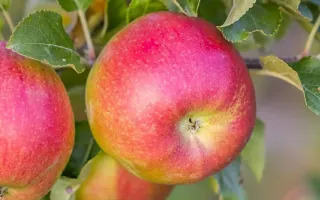
Fruits are above-average size (average fruit mass 180 g), one-dimensional, round-conical, with weakly ribbed surface. Skin is dry to touch, rough, dull. Main color at harvest is greenish, at consumer ripeness — greenish-yellow; covering color is diffuse red over the entire fruit. Numerous large, gray, clearly visible lenticels. Peduncle medium length and thickness, straight, upright. Calyx cup is deep, acute-conical, narrow. Calyx is non-falling, open. Disk is medium depth, wide, folded. Core is small, onion-like. Seed chambers are half-open, medium size. Subcalyx tube medium length, narrow, funnel-shaped. Seeds are medium, egg-shaped, brown.
Flesh is yellow, tender, semi-oily, fine-grained, sweet-tart flavor (4.5 points), with medium aroma.
Fruits appear visually attractive (4.5 points). Chemical composition: dry matter — 17.5%, ascorbic acid — 3.9 mg/100g, sugars — 12.9%, organic acids — 0.85%, sugar-acid ratio — 15.20.
Harvest ripeness occurs in the third decade of October.
Fruits store well in storage (up to 176 days), consumer period lasts from early October to mid-March. Fruit attachment strength is very good. Fruit drop is practically absent. Fruit quality is high, transportability is medium. Variety is of universal use, though primarily used as dessert.
Best pollinators for the Starry variety are Jonathan, Winter MOSVIR, and Golden Delicious.
Performs well on all rootstock types, both seedling apple trees (eastern and forest types) and vegetatively propagated rootstocks (EMX1, EMIХ, MM 106, etc.). The variety forms well, is not demanding regarding soil conditions or location, though best performance is observed on well-lit, ventilated, and fertile sites. Mechanized fruit harvesting is acceptable.
Enters fruiting in the 4th-5th year. Yield is 172 centners per hectare. For the first 10 years, yield exceeds Jonathan by 152%, and in the following five years by 83%. Fruit production is regular.
Cold hardiness in the North Caucasus region is high. The variety exhibits comprehensive resistance to major fungal diseases (scab, fruit rot, powdery mildew, black canker).
Advantages of the variety: high yield, fruit quality, and consumer value, comprehensive resistance to fungal diseases.
Disadvantages of the variety: slight fruit wilting in storage under non-regulated conditions.
Crop & resistance
Crop
Disease resistance
Specifications
| Type of Sort | |
|---|---|
| Catalog | Catalog → Apple |
Store offers
Prices are updated on loadLoading offers…
Aggregator catalog: prices are collected automatically from store websites, normalized by AI and converted at the current exchange rate. Before ordering, confirm the price and availability on the store's website. This block is not indexed by search engines — the data is loaded after the page opens.
Not yet комментариев. Be the first!
Alternatives
Apple saplings · similar varieties




See also
Often considered together with this variety


Recently viewed
Products you’ve viewed on this site
Reviews · 0