


SKU #3358
·
283 views
Apple Winter Striped
Apple
Type of Variety
Winter Apple Variety
Your mark
0 votes
0% positive ratings
Store offers · 2 from 2 stores
2 offers in 2 stores — from 4.42 € per seedling.
Available at: Сад Мордовии · sadovii-ru
Prices are collected automatically from store websites and converted at the current exchange rate. Check the price and availability on the store website before ordering.
Description
Winter variety, obtained at the VNIIS named after I.V. Michurin by crossing Borovinka with Champagne Renet. Authors: Z.I. Ivanova, G.A. Lobanov, V.K. Zaets, S.I. Isaev. Approved for the Middle Volga region. Widely grown in Tambov Oblast and neighboring regions.
Medium-sized tree with an elongated-oval crown, medium foliage, with raised skeletal branches that diverge from the trunk nearly at a right angle, quite compact. Bark on the trunk and main branches is smooth, brownish in color with a yellowish tint. Predominant type of fruiting structures: simple rings, spear-like formations, short fruiting spurs.
Shoots with brown bark, straight, medium size, strongly hairy, with numerous stipules. Leaves are large, elongated-elliptical or elongated-oval. Leaf blade is flat or slightly concave, curved at the base, positioned at a right angle relative to the shoot, medium hairiness. Leaf surface finely wrinkled. Leaf margin slightly large-wavy, with small, round, bluntly toothed serrations. Petiole thick, medium length, stipules medium size or nearly equal to petiole length.
Flowers medium-sized, white, petals oval. Stigma style medium, stigma level with stamens. Flower buds smooth, medium size.
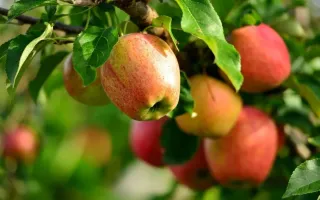
Fruits (see photo) medium or above medium size, weighing 140-170 g, flat-round or round shape, one-dimensional. Skin smooth. Primary color at harvest readiness is greenish-yellow, at consumer readiness — golden-yellow. Covering — on most of the fruit as broad red stripes and streaks. Numerous, large, clearly visible lenticels distributed over the entire fruit surface. Appearance rating — 4.3 points. Fruit stalk short, thick, usually protrudes beyond the calyx, in central fruits usually enclosed within the calyx. Calyx deep, medium. Receptacle moderately deep, wide, smooth. Calyx cup closed or semi-open, with loosely closed sepals. Seed cavity bulbous, medium size. Sub-calyx tube funnel-shaped. Chambers semi-open. Seeds medium, broad, conical, brownish color with a reddish tint.
Fruit flesh cream-colored, loose, tender, juicy, suitable for both table and dessert use. Flavor rating — 4.5 points. Chemical composition of fruits: sugars — 11.8%, titratable acids — 0.35%, ascorbic acid — 27.8 mg/100g.
Harvesting occurs in the second half of September.
Fruits exhibit high storability. Optimal storage temperature is 0+1°C. Fresh consumption period begins in mid-October and ends in early April. Transportability is good. Fruit quality is high.
Fruits are consumed fresh, but are also excellent for processing: juices, dried fruits, jams.
Self-fertile, but yield increases with the presence of other varieties in the orchard. Best pollinators: Welles, Pêpin Shafran.
Distinguished from many varieties by good or abundant yields in early fruiting years. Fruit production begins on the 3rd-4th year of tree growth in the orchard. Young trees bear fruit annually, mature trees show irregular fruiting. High-yielding variety. At 15 years old, yield per tree reaches 80 kg.
Advantages of the variety are most pronounced when grown on dwarf rootstock and regularly pruned.
Moderately winter-hardy, in the winters of 1968/69 and 1971/72, slight darkening of the core in one-year growth was observed by 0.5-1.0 point. Drought resistance is medium. In wet years, leaves are affected by scab, fruits are nearly unaffected.
Advantages of the variety: high early fruiting, abundant yield, large, attractive, tasty winter fruits, high storability.
Disadvantages of the variety: medium winter hardiness, medium resistance to fungal diseases.
Video · 3 videos
Suggest a video →Crop & resistance
Crop
Disease resistance
Specifications
| Type of Variety | |
|---|---|
| Catalog | Catalog → Apple |
No reviews yet. Be the first to share your experience.
Alternatives
Apple saplings · similar varieties


See also
Often considered together with this variety





Recently viewed
Products you’ve viewed on this site
Reviews