


SKU #3354
·
614 views
Apple Star
Apple
Type of Variety
Winter Apple Variety
Your mark
0 votes
0% positive ratings
Store offers · 5 from 5 stores
5 offers in 5 stores — from 7.74 € per seedling.
Available at: 1sad · AgronomVIP · moscow-garden24-ru · plodovyimir-ru · Agromir
Prices are collected automatically from store websites and converted at the current exchange rate. Check the price and availability on the store website before ordering.
Description
Winter variety selected by the All-Russian Scientific Research Institute of Genetics and Selection of Fruit Plants named after I. V. Michurin. Breeder S. F. Chernenko. Obtained by crossing Lithuanian Pippin with Anise. Widely distributed, registered in regions of the Northwestern, Central, Volga-Vyatka, and Middle Volga areas of the Russian Federation, used in breeding.
Trees are vigorous, with rounded crowns in youth, and as they reach full fruiting, the crown becomes broader, spreading, slightly drooping. The crown features thick skeletal branches and many thin twigs. Fruit set is concentrated in the middle and outer parts of the crown, primarily on spurs and short branches, rarely on young buds.
Shoots are long, thin, red-brown, heavily hairy. Leaves are small, oval, matte, with serrated margins and short petioles. Stipules are thread-like.
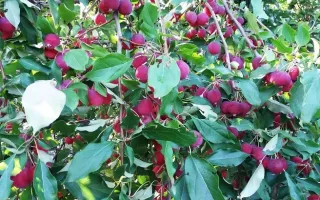
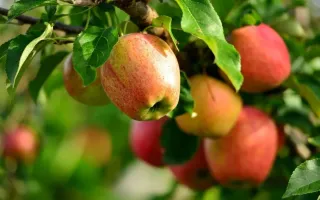
Fruits (see illustration) are medium or slightly smaller in size, flattened-round in shape, with weakly noticeable ribs. Surface is smooth. Main color is light green, with a diffuse dark-red blush covering nearly the entire fruit surface, accompanied by a strong waxy bloom. The pedicel of the central fruit on the fruiting cluster is short and thin. The calyx is closed over a small funnel-shaped subcalyx tube. Chambers are closed. No central cavity.
Flesh is greenish, with a pinkish hue near the skin in intensely colored fruits, juicy, finely textured, with good sour-sweet taste. Chemical composition of fruits: total sugars — 10.3%, titratable acidity — 0.64%, dry matter — 13.2% on dry weight, ascorbic acid — 15.0 mg/100g, P-active catechins — 134.8 mg/100g.
Ripening is winter. Under storage conditions, fruits can be kept until February-March (207 days). The variety responds well to pruning (thinning), which helps increase fruit size.
Fruit production begins on the 5th–7th year (after grafting). Annual yield. Winter hardiness is moderate. Resistance to scab is high.
Advantages of the variety: regular yield, high fruit quality, intense fruit coloration, and long storage life.
Disadvantages of the variety: fruits become smaller with tree age, requiring regular pruning.
Video · 4 videos
Suggest a video →Crop & resistance
Crop
Disease resistance
Specifications
| Type of Variety | |
|---|---|
| Catalog | Catalog → Apple |
No reviews yet. Be the first to share your experience.
Alternatives
Apple saplings · similar varieties


See also
Often considered together with this variety



Recently viewed
Products you’ve viewed on this site
Reviews