


SKU #3389
·
309 views
Krasnoyarskoe Sladkoe
Apple
User rating
0 votes0% positive reviews
No ratings yet — be the first.
Type of Sort
Winter Apple Variety
Tree; Canopy Shape
Round Canopy
Fruit; Fruit Shape
Round
Fruit; flesh color
Greenish-white
About product

This variety was developed at the Krasnoyarsk Experimental Fruit Station by N. N. Tikhonov, A. S. Tolmacheva, and I. A. Vetkas through crossing the early variety 'Lalетино' with 'Papirovka'. The variety is included in the State Register for Krasnoyarsk Krai, Irkutsk Oblast, and the republics of Khakasia, Tuva, and Buryatia. It is also cultivated in Kemerovskaya, Novosibirskaya, and Omskaya Oblast…
Type of Sort
Winter Apple Variety
Tree; Canopy Shape
Round Canopy
Fruit; Fruit Shape
Round
Fruit; flesh color
Greenish-white
Description
This variety was developed at the Krasnoyarsk Experimental Fruit Station by N. N. Tikhonov, A. S. Tolmacheva, and I. A. Vetkas through crossing the early variety 'Lalетино' with 'Papirovka'. The variety is included in the State Register for Krasnoyarsk Krai, Irkutsk Oblast, and the republics of Khakasia, Tuva, and Buryatia. It is also cultivated in Kemerovskaya, Novosibirskaya, and Omskaya Oblasts. It is mainly grown in collective orchards across various Siberian regions.
The tree in nurseries is fast-growing, and growth slows with the onset of fruiting. The crown is round, moderately dense, and well-leaved. The bark is smooth and greenish. Fruit-bearing is concentrated on simple and complex rings, on 1- to 3-year-old wood.
Shoots are straight, round in cross-section, medium thickness, brownish-brown, slightly hairy. Buds are pressed, small, hairy. Leaves are medium-sized, egg-shaped, short-tapered, with serrated margins, coarsely veined, light green. Hairs are moderate. Petioles are medium, curved at the base, hairy. Stipules are small, lanceolate, falling off slightly earlier than leaves.
Flowers are small, small-cup-shaped, pinkish, moderately fragrant. Petals are egg-shaped. Stigma columns are medium. Stigmas are positioned higher or at the same level as anthers. Best pollinators: Alenushka, Lada, Fonnik, Zhivinka, Mana.
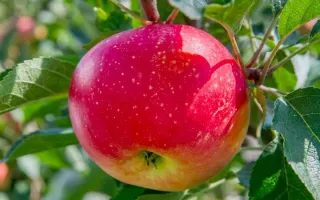
Fruits (see illustration) are large for Siberia, usually 50-60 g, some up to 120 g. Fruit shape is round, tapering toward the calyx, some are unequal-sided, with a seam. Fruit color is greenish. Cover color — covering 2/3 of the fruit, blurred, brownish-red, brick-red in favorable years, merging into broad stripes during storage. Fruit stem is medium, straight, sometimes short. Thickness is medium. Vessel is small, narrow, sometimes swollen. Rust is in the form of rays. Calyx is half-open, small, in a small, narrow, slightly ribbed dish. Sub-calyx tube is short, narrow, sac-like. Axial cavity does not connect with seed chambers, which often contain 15 seeds.
Flesh is greenish, dense, finely grained, juicy. Flavor is sour-sweet, with a spicy note, moderate aroma.
Chemical composition of fruits: dry matter — 13.5%, sugars — 9.9%, titratable acids — 0.90%, sugar-to-acid ratio 11.0, ascorbic acid — 25.0 mg/100g to 40.5 mg/100g, P-active substances — 160 mg/100g, tannins — 0.13%.
Harvesting begins in early September. Fruit storage life extends until December 15-20, sometimes until October 15 in certain years.
Fruits are consumed fresh, suitable for compotes, purées, juices.
This is a medium-early fruiting variety. Begins fruiting at 5-6 years. Average yield 73 centners/ha, highest at 15 years — 137 centners/ha. Fruit quality is moderate. Fruit-bearing is irregularly periodic.
Winter hardiness among large-fruited semi-cultivars is good. It withstood harsh winters of the 1960s and 1980s without tree loss, although the sum of negative average daily temperatures during the winter of 1968/69 was -2926°, air temperature minimum -41.8º, soil temperature -48.4º (in February). Flower buds were well preserved.
This variety has good recovery ability. Resistant to scab.
Fruits have not been affected for 30 years, leaves — very slightly (0.6 points), drought resistance — moderate.
Advantages of the variety: fruit size and high ascorbic acid content, universal use. Resistance to scab. Winter storage period for fruits.
Disadvantages of the variety: late fruiting onset, unequal-sided fruits.
Video · 1 video
Suggest a video →Crop & resistance
Crop
Disease resistance
Specifications hover over for a hint about the specification
| Type of Sort | |
|---|---|
| Tree; Canopy Shape | |
| Fruit; Fruit Shape | |
|
Fruit; flesh color
Fruit; flesh color
Color of the fruit flesh. There are red, pink, yellow, and brown colors. |
|
| Fruit; Fruit Color (Base Color) | |
| Fruit; Blush (Blush Color) | |
| Fruit; Fruit mass | 50-60 |
| Fruit; Lying | 3-3.5 |
| Cold Resistance | |
| Catalog | Catalog → Apple |
Store offers
Prices are updated on loadLoading offers…
Aggregator catalog: prices are collected automatically from store websites, normalized by AI and converted at the current exchange rate. Before ordering, confirm the price and availability on the store's website. This block is not indexed by search engines — the data is loaded after the page opens.
Not yet комментариев. Be the first!
Alternatives
Apple saplings · similar varieties



See also
Often considered together with this variety


Recently viewed
Products you’ve viewed on this site
Reviews · 0