


SKU #4155
·
258 views
Early Nebedzhaevskaya
Cherry Plum
User rating
0 votes0% positive reviews
No ratings yet — be the first.
Assignment
Preservation
Ripening Period
Early
Flavor
Acidic (sugar <8%)
Flesh Density
Dense
Store offers · 1 from 1 stores
Prices are updated on loadLoading offers…
Available at: ЛЕЧЕЦ
Aggregator catalog: prices are collected automatically from store websites, normalized by AI and converted at the current exchange rate. Before ordering, confirm the price and availability on the store's website. This block is not indexed by search engines — the data is loaded after the page opens.
About product

Seedling from open pollination of the 'Purpurovaya' variety. Originator — Crimean Experimental and Selection Station of the All-Russian Research Institute of Plant Growing named after N.I. Vavilov. Author: G.V. Yeremin. Approved for the North Caucasus region in 1987. Tree strongly growing, with an oval, dense crown. The trunk is slightly twisted, dark gray, medium thickness, with few lenticels. S…
Assignment
Preservation
Ripening Period
Early
Flavor
Acidic (sugar <8%)
Flesh Density
Dense
Description
Seedling from open pollination of the 'Purpurovaya' variety. Originator — Crimean Experimental and Selection Station of the All-Russian Research Institute of Plant Growing named after N.I. Vavilov. Author: G.V. Yeremin. Approved for the North Caucasus region in 1987.
Tree strongly growing, with an oval, dense crown. The trunk is slightly twisted, dark gray, medium thickness, with few lenticels. Shoots are vertical, thin — 20-25 mm in diameter, with moderate anthocyanin coloring at the tip. The flesh on the sunny side is intensely red-purple. Branches, spurs, and skin are short and medium length; they are short-lived — up to 3-4 years. Flower buds are small, round, and isolated; the scales of the bud are green with pink edges. Leaf blade is horizontal, small, 57 mm long, 34 mm wide, oval in shape. Base is arched, apex is pointed, upper surface is dark green and glossy, lower surface has weak pubescence. Leaf margin is finely toothed, small, with slight undulation. Stipules are very small, round, located at the base of the leaf. Petiole is medium length — 12-16 mm, medium thickness 1.1 mm, with medium-depth groove, very weak pubescence, intense anthocyanin coloration. One flower develops from a bud, many flowers on one-year shoots. Flower size is medium — 23-25 mm, corolla is flat and slightly closed. Petal is medium-sized, 11 mm long, 7.5 mm wide, oval, slightly fringed, with wavy apex. Color is white, pink at the base; stigma is yellow. Numerous stamens — 26 or more, filament length 3-8 mm, slightly curved. Stigma is at the same level or below the stamens, round in shape. Calyx is bell-shaped. Calyx lobes are pressed, oval, 3 mm long, 2.5 mm wide. Pedicel is medium length — 21-13 mm, thin.
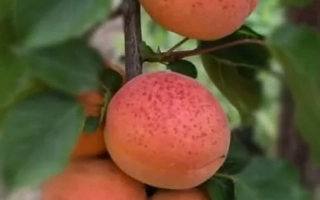
Fruit is small or medium — height 27 mm, width 29 mm, thickness 27 mm, weight 18 g, round, medium skin thickness, symmetrical, dark ventral suture, smooth along the entire length, apex rounded, small depression. Skin is thick and elastic, easily separates from flesh, no waxy coating. Main color is yellow, covering color is red-purple, solid, no lenticels. Flesh is yellow-green, darkens slightly in air, dense, fine-fibrous, slightly sweet, high acidity, low juiciness, easily separates from stone. Stone is small, length 14 mm, width 10 mm, thickness 6 mm, weight 0.56 g, light brown color, oval-elliptical shape on the ventral suture side, symmetrical, maximum diameter in the middle. Ridge is not developed, surface smooth. Ventral suture width is narrow. Base is wide, narrowly rounded, apex pointed. Pedicel is medium — 17 mm, thin — 1.0 mm, without pubescence.
Fruits are valuable for canning. Canning evaluation: juice with pulp — 4.6 points, compote — 4.5 points, jam — 4.6 points. Fruits contain, per fresh weight: dry matter 11.37%, sugars 6.7%, including sucrose 4.3%, monosaccharides 2.4%, acids 2.0%, sugar-acid index 3.3, pectin substances 0.60%, polyphenols 425 mg/100g, flavonols 36.9 mg/100g, catechins 34.9 mg/100g, anthocyanins 32.3 mg/100g, ascorbic acid 8.6 mg/100g.
Blooms early — in early April. Self-sterile. Ripens very early — by the end of June. Winter hardiness is moderate, drought resistance is moderate. Disease resistance is high.
Advantages: high canning quality of fruits, early ripening, easy stone separation.
Disadvantages: small fruit size, insufficient winter hardiness, strong growth.
Crop & resistance
Crop
Specifications hover over for a hint about the specification
| Assignment | |
|---|---|
| Ripening Period | |
| Flavor | |
| Flesh Density | |
|
Fruit Color
Fruit Color
The fruit color of tomato varieties is influenced by the combination of skin and flesh color. Some varieties have transparent skin, others — yellow. When combined differently, the fruits can acquire quite diverse colors. The fruit color is affected by pigments (lycopene) and thei... |
|
|
Fruit Weight
Fruit Weight
Tomato fruits are classified by weight as: very small — less than 20 grams; small — 20 — 50 grams; medium — 50 — 100 grams; large — 100 — 200 grams; very large — more than 200 grams. |
18 |
| Pollinator | |
| Pit Size | |
| Catalog | Catalog → Cherry Plum |
Not yet комментариев. Be the first!
Alternatives
Cherry Plum · similar varieties


See also
Often considered together with this variety


Recently viewed
Products you’ve viewed on this site
Reviews · 0