
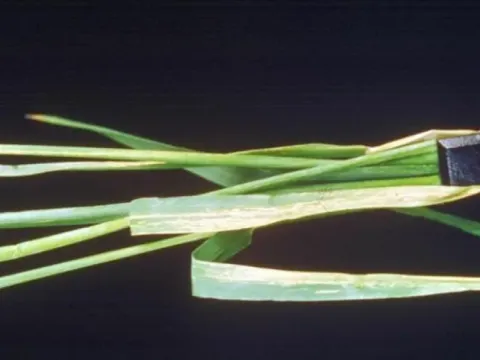
Barley stripe mosaic virus
Mastrevirus hordei
The causal agent of this disease is the Barley stripe mosaic virus (BSMV), which is a significant pathogen affecting various monocotyledonous crops worldwide.
What the section contains
Barley stripe mosaic virus
This virus is characterized by its ability to spread systemically throughout the host plant, disrupting normal cellular functions and metabolic processes.
It is known for being highly seed-borne, which poses a significant challenge for maintaining clean seed stocks in agricultural production.
The virus particle consists of single-stranded RNA, which uses the host plant's internal machinery to replicate efficiently within plant cells.
Due to its high level of genetic diversity, different strains of the virus can exhibit varying degrees of virulence across different barley cultivars.
The most distinctive symptom is the appearance of pale green, yellow, or white streaks and stripes running parallel to the leaf veins.
As the infection progresses, these stripes may coalesce into larger blotches, sometimes leading to necrosis or the death of leaf tissue.
Infected plants typically show signs of stunting, reduced tillering, and an overall lack of vigor compared to healthy neighboring plants.
Reproductive organs are also affected; the spikes may appear deformed, and in severe cases, the plant may fail to produce viable seeds entirely.
Early-season infections often result in more pronounced symptoms, while late-season infections might appear as subtle mottling on the upper leaves.
Transmission occurs primarily through infected seeds, making the seed supply chain a critical control point for managing the disease.
Secondary spread within the field occurs through mechanical contact between foliage, which is facilitated by wind, rain, or human/machine movement.
Environmental conditions such as cool, moist weather during the early vegetative stages promote rapid symptom expression and viral multiplication.
High planting density increases the likelihood of physical contact between plants, thereby accelerating the spread of the virus throughout the crop canopy.
The presence of alternative host plants, including certain grassy weeds, can provide a reservoir for the virus to persist between growing seasons.
The disease significantly reduces the photosynthetic capacity of the plant, which directly impacts the filling and development of the grain.
Yield losses can be substantial, often reaching double-digit percentages depending on the timing of infection and the susceptibility of the variety.
Beyond quantity, the quality of the harvest is often compromised, leading to lower test weights and reduced marketability for the grain.
Infected crops are often less resilient, showing increased vulnerability to secondary environmental stressors and other soil-borne diseases.
The economic burden of the disease is magnified by the fact that infected seeds from one year's harvest serve as the inoculum for the next.
The most effective strategy is the systematic use of disease-free, certified seeds to prevent the initial introduction of the pathogen into the field.
Implementing a rigorous crop rotation strategy helps to break the life cycle of the virus by removing the host plants for successive seasons.
Spatial isolation between seed production fields and commercial cereal crops is essential to minimize the risk of mechanical transmission.
Active management of weed populations, which may harbor the virus, is a necessary practice for maintaining the overall health of the agroecosystem.
- Utilize certified disease-free seeds.
- Practice regular crop rotation.
- Maintain spatial separation of fields.
- Control grassy weed populations.
- Select resistant or tolerant varieties.