
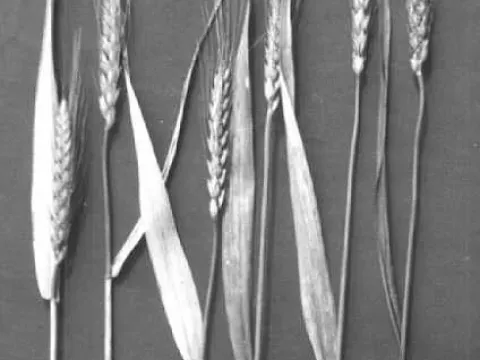
Barley yellow dwarf
Closterovirus flavitritici
Barley yellow dwarf virus (BYDV) is a serious viral disease affecting cereals, traditionally associated with the Luteoviridae family and previously categorized within the Closterovirus-like complex. It is an obligate parasite that specifically infects the phloem tissues of host plants.
What the section contains
Barley yellow dwarf
The virus particles are spherical, non-enveloped, and contain single-stranded RNA. Being a highly specialized pathogen, it relies entirely on its insect vectors for transmission between plants, as it cannot be spread mechanically or through seed.
The virus is circulative and non-propagative in its vectors, meaning it is ingested by aphids, enters the hemolymph, moves to the salivary glands, and is injected into the plant during feeding.
Numerous aphid species act as vectors, most notably Rhopalosiphum padi and Sitobion avenae. The efficiency of transmission depends on the specific strain of the virus and the aphid species involved.
Once inside the host, the virus causes systemic infection. By localizing in the sieve tubes, it effectively disrupts the translocation of photoassimilates, starving the roots and developing reproductive structures.
The classic symptoms include a distinct yellowing or reddening of the leaf tips, which gradually spreads downwards. In wheat, this discoloration is often quite vivid, ranging from bright yellow to deep orange or purple hues.
Stunting is the hallmark symptom, resulting from shortened internodes. Affected plants appear shorter than healthy ones, which is particularly noticeable in patches within a field during the early growth stages.
Infected plants often exhibit increased tillering, though these extra tillers are typically stunted and fail to produce viable grain heads. This results in an uneven and sparse canopy development.
Root systems of infected plants are severely underdeveloped, making them prone to drought stress. The inability of the plant to maintain water balance further exacerbates the discoloration and tissue necrosis.
Heading may be delayed or incomplete. When heading occurs, the spikes are often small, sterile, and produce significantly lower yields compared to healthy neighboring plants.
The development of the disease is heavily dependent on the population dynamics of aphids. A warm, dry autumn provides optimal conditions for aphid multiplication and migration into newly emerged winter cereal crops.
The presence of a "green bridge" is critical. Volunteers (seedlings from the previous harvest) and grassy weeds serve as reservoirs for the virus during the summer, allowing it to persist until the next cropping cycle.
Optimal temperatures for aphid activity and viral replication generally range between 15°C and 22°C. Mild winter conditions allow for both the vector and the virus to survive, leading to earlier spring outbreaks.
Early planting of winter cereals increases the risk of infection, as the young, susceptible seedlings are exposed to the autumn migration of viruliferous aphids.
Wind patterns can facilitate the long-distance transport of aphids, potentially introducing new strains of the virus into a region even if local populations are managed effectively.
The primary economic impact is a drastic reduction in grain yield. Severe infections can lead to yield losses exceeding 30–50% due to reduced grain filling and poor spike development.
Grain quality is negatively affected, with lower test weights and reduced protein content, rendering the harvest less valuable for both milling and feed purposes.
Infected crops show significantly lower winter hardiness. The metabolic disruption leaves plants susceptible to frost damage, leading to higher rates of winterkill in affected areas.
The disease usually occurs in patches, which causes uneven maturity across the field, leading to increased grain loss during mechanical harvesting and difficulty in crop management.
Susceptibility to secondary pests and fungal diseases increases, as the plant's natural defense mechanisms are weakened by the systemic viral infection.
Adjusting planting dates is the most effective management tool. Delaying sowing until after the peak autumn flight of aphids significantly reduces the probability of primary infection.
Sanitation practices, such as destroying volunteer cereals and grassy weeds in and around fields, eliminate the virus reservoirs and reduce the local aphid pressure before the new crop emerges.
Using systemic insecticidal seed treatments provides a protective window during the critical early growth stages, shielding young wheat plants from aphid feeding and potential inoculation.
Genetic resistance is the long-term solution. Breeding programs are focused on incorporating resistance genes into commercial wheat varieties to limit viral replication or vector preference.
Monitoring aphid populations using yellow sticky cards and applying timely foliar insecticides can prevent the secondary spread of the virus within the field, protecting yield potential.