
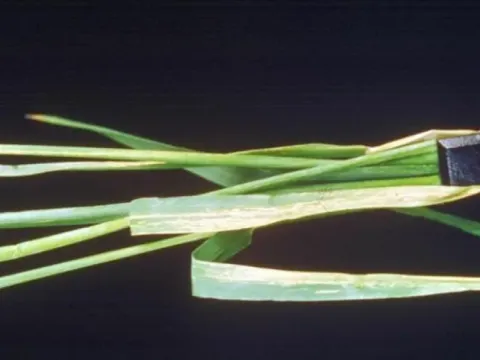
Barley stripe mosaic
Rymovirus hordei
The first symptoms of Barley stripe mosaic typically appear at the tillering or stem elongation stage as distinct light yellow or white stripes on leaves.
What the section contains
Barley stripe mosaic
These stripes run parallel to the leaf veins and, as the disease progresses, the affected tissue often turns necrotic and brown, causing premature wilting.
Infected plants exhibit severe stunting and reduced height compared to healthy plants, making them appear patchy and uneven in the field.
The heads of infected plants are often deformed, smaller than normal, and may show incomplete seed set or complete sterility due to the viral impact.
Leaves may show signs of curling and twisting, which disrupts the photosynthetic capacity and severely hampers the overall development of the crop.
The disease is caused by the Barley stripe mosaic virus (BSMV), which is the type species of the genus Hordeivirus.
The virus consists of rod-shaped particles with a tripartite, single-stranded RNA genome that allows for rapid adaptation to new hosts.
The most critical aspect of the virus biology is its high efficiency in seed transmission, allowing it to persist across generations and geographic regions.
In addition to seed transmission, the virus is easily spread mechanically through physical contact between healthy and infected foliage in the field.
The virus does not persist in the soil for long periods, so infected seeds and infected plant debris serve as the primary sources of seasonal inoculums.
The spread of the virus within a crop canopy is highly dependent on planting density, as high-density fields facilitate more frequent contact between plants.
Environmental conditions such as moderate temperatures and high humidity promote the faster development of symptoms and the systemic movement of the virus.
The use of farm-saved seeds, particularly from fields that had symptomatic plants in the previous year, is the primary driver of disease outbreaks.
Weed hosts, specifically certain grass species, can act as reservoirs for the virus, potentially increasing the risk of infection in adjacent barley fields.
Early-season conditions that favor rapid vegetative growth are optimal for the virus to enter and establish itself within the vascular system of the host.
Barley stripe mosaic virus significantly reduces crop productivity, leading to yield losses that typically range from 10% to 30%, or even higher in severe cases.
The yield reduction is largely due to the production of shriveled, light-weight kernels and a high rate of spikelet abortion, resulting in fewer seeds per head.
Infected crops show poor grain quality, which negatively affects malting and feed characteristics, often rendering the yield unsuitable for standard commercial use.
The systemic infection weakens the plant's physiological state, making it significantly more susceptible to secondary fungal and bacterial infections.
Economic consequences include not only direct harvest losses but also the increased costs associated with cleaning or replacing entire batches of contaminated seeds.
The most effective strategy for managing Barley stripe mosaic is to use only high-quality, virus-tested, and certified disease-free seed lots.
Regular scouting and monitoring of fields during the early stages of growth allow for the identification and removal of primary infection sources.
Implementing a proper crop rotation strategy helps to reduce the survival of the virus and minimize the potential for carry-over infection in the soil or debris.
Maintaining strict sanitation of farm machinery and tools is vital to prevent mechanical transmission of the virus between different field areas.
- Use of resistant or tolerant barley cultivars.
- Effective management of grassy weed populations.
- Strict adherence to certified seed sourcing programs.