
Barley yellow dwarf
Polerovirus cydvrpv
The causative agent of this disease is the Barley yellow dwarf virus (BYDV), which belongs to the Polerovirus genus. It is an obligate parasite that requires specific insect vectors for transmission.
What the section contains
Barley yellow dwarf
Aphids, including the bird cherry-oat aphid and the English grain aphid, are the primary vectors. The virus is acquired when aphids feed on infected plants and is then transmitted systemically to healthy crops.
The virus has a wide host range, infecting major cereals such as barley, wheat, oats, rye, and corn. Numerous wild grass species also serve as persistent reservoirs for the virus throughout the year.
BYDV particles are confined to the phloem tissue of the host plant. By multiplying in these tissues, the virus obstructs the translocation of nutrients, leading to physiological failure.
Different strains of the virus are known to be transmitted by different aphid species, which necessitates a diverse approach to monitoring and diagnostic testing in affected areas.
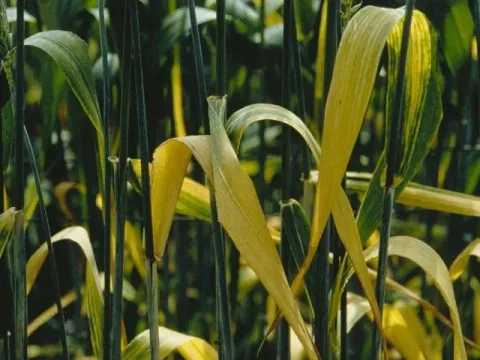
The characteristic signs of infection include leaf discoloration. In barley, this manifests as vibrant yellow or golden tips, while in wheat, leaves often turn reddish or purple.
Stunting is a key diagnostic feature, caused by shortened internodes. Plants infected at early growth stages remain significantly smaller than healthy ones and fail to develop properly.
The plants often display excessive tillering, but the resulting tillers are weak and may fail to produce a grain-bearing head. If heads are produced, they are typically small, distorted, or empty.
Root system development is severely compromised, making infected plants highly susceptible to drought and nutritional stress, which exacerbates the visible symptoms of the disease.
Symptoms often appear in patches within a field, reflecting the landing patterns of the initial aphid vectors. These infected patches can expand over time as secondary spread occurs.
The development of the disease is strictly linked to aphid population dynamics. Mild autumns and warm winters are highly conducive to the survival and multiplication of aphid vectors.
Early sowing of winter cereals in warm, dry autumn conditions exposes seedlings to high pressure from migrating aphids, significantly increasing the probability of early-stage infection.
Drought stress during the summer months encourages the migration of aphids from drying wild grasses into emerging cereal crops, creating a bridge for the transmission of the virus.
Weather conditions that favor rapid aphid reproduction, generally temperatures between 15°C and 20°C, accelerate the rate of virus transmission across the field.
The presence of volunteer cereals and grassy weeds provides a continuous bridge of infection. Fields located near such areas are at a much higher risk of outbreaks.
The economic impact of Barley yellow dwarf is significant, as it leads to drastic reductions in grain yield. Early-season infections can cause yield losses ranging from 50% to over 80%.
Beyond yield volume, grain quality is also severely affected. The resulting seeds are often shriveled, have low test weight, and possess poor germination characteristics, making them unsuitable for seed stock.
Infected crops show increased susceptibility to other pathogens, such as root rots and fungal leaf diseases, further damaging the overall health and stand density of the crop.
Costs are compounded by the need for repeated insecticide applications and the potential total loss of the crop in heavily infested fields, forcing farmers to re-seed or abandon portions of their land.
The disease also increases the risk of lodging, which complicates harvesting operations and leads to additional grain losses during the combine process.
Management strategies focus on minimizing aphid-plant contact. Utilizing systemic insecticidal seed treatments is one of the most effective ways to protect seedlings during the critical establishment phase.
Adjusting planting dates to avoid the peak periods of aphid migration is a fundamental cultural control practice. Delayed planting is often recommended to reduce exposure in autumn.
Sanitation practices, including the eradication of volunteer cereals and grassy weeds in and around fields, are crucial to reducing the primary inoculum source for the next season.
Breeding for host-plant resistance or tolerance remains the most sustainable and efficient approach. Utilizing resistant cultivars mitigates the need for extensive chemical usage.
- Monitoring aphid populations with yellow sticky traps.
- Applying foliar insecticides when aphid thresholds are exceeded.
- Maintaining crop rotation to break the viral disease cycle.