
Barley stripe mosaic
Hordeivirus hordei
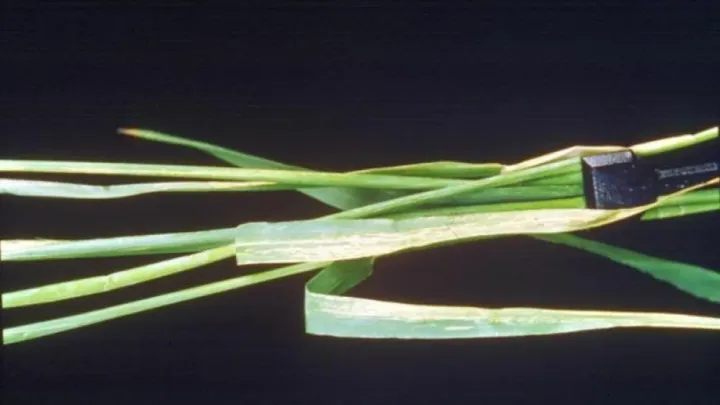
Description
Symptoms
Initial symptoms include pale green or yellowish streaks appearing parallel to the leaf veins, which gradually extend over the entire leaf blade.
As the infection progresses, these streaks may coalesce to form mosaic patterns, or become necrotic, leading to the yellowing and eventual death of the affected tissue.
Infected plants typically exhibit significant stunting and reduced tillering compared to healthy plants, resulting in a generally poor crop stand.
During the heading stage, infected barley plants often show deformed or incomplete ears, which may be partially or completely sterile.
- Linear leaf striping
- Chlorotic and necrotic patches
- Stunted growth
- Deformed ears
- Reduced grain yield
Pathogen
The causative agent of the disease is the Barley stripe mosaic virus (BSMV), belonging to the Hordeivirus genus. This RNA virus is characterized by a high ability to transmit horizontally through mechanical contact.
A distinctive feature of this pathogen is its efficient transmission through the seeds of infected plants, which acts as the primary source of spread over long distances.
The virus is also transmitted through contact between the foliage of infected and healthy plants, often facilitated by agricultural machinery or animal movement in the field.
Transmission through pollen is another important mechanism that contributes to the spread of the virus within breeding plots and experimental fields.
The virus particles are rod-shaped and exhibit high stability, allowing them to remain infectious within dormant seeds for several years.
Conditions for development
The primary factor for disease development is the use of contaminated seed, which introduces the pathogen into new environments.
Favorable conditions for virus spread include moderate temperatures during the growing season and frequent mechanical contact between plants.
High plant density increases the efficiency of mechanical transmission, allowing the virus to spread rapidly across a field during windy conditions.
Late sowing or poor environmental management can exacerbate the negative effects of the virus, making the crop more susceptible to the disease.
The presence of susceptible wild grasses or weeds around the field can provide a reservoir for the virus, promoting carry-over infections between seasons.
Why it matters
The economic impact of barley stripe mosaic is significant, with yield losses often ranging from 10% to 50% depending on the strain and the timing of infection.
Infected plants produce smaller, shriveled grains of lower quality, which makes the harvest unsuitable for seed purposes and lowers its market value.
Viral infection disrupts the plant's physiological processes, including photosynthesis, which reduces the overall resilience of the crop to other stressors.
Secondary infections by opportunistic pathogens are more common in virus-weakened plants, further exacerbating the loss of yield and quality.
The systematic nature of the virus affects the entire plant, leading to stunted development and failure to reach full grain-filling potential.
Protection
The most crucial control measure is the use of certified, virus-free seed sourced from reliable, tested production fields.
Strict crop rotation should be followed to reduce the accumulation of the virus and minimize the chance of contact with contaminated residues.
Weed management is essential, as many grasses can serve as alternative hosts for the virus, keeping the pathogen active in the field.
Developing and planting resistant or tolerant barley cultivars is the most sustainable approach to managing the risks associated with this disease.
Implementing quarantine and phytosanitary inspections for imported seeds is vital to prevent the introduction of new virulent strains into uninfected areas.
Discussion
No discussions yet — be the first.