
Banana streak virus
Badnavirus alphavirgamusae
Description
Symptoms
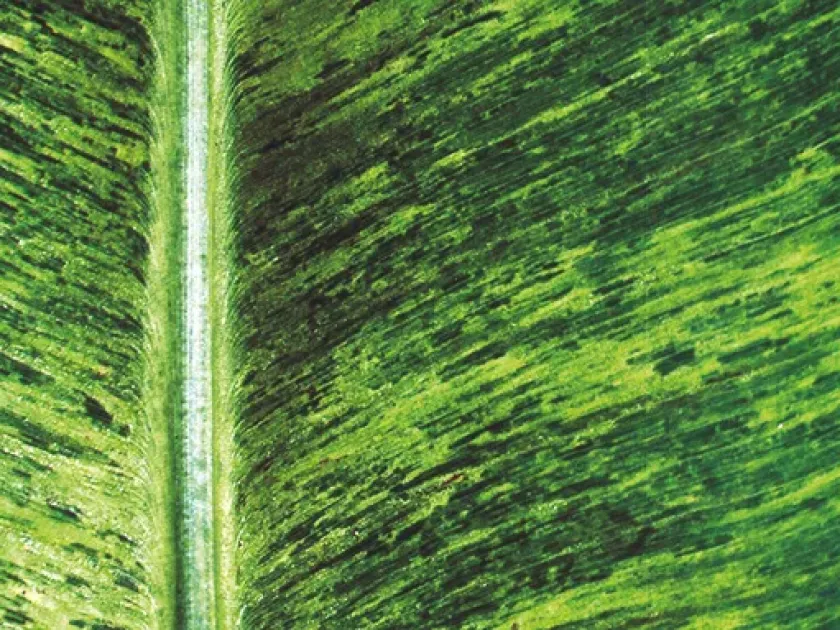
The primary visual sign is the presence of characteristic chlorotic streaks on banana leaves. Initially yellow, these streaks darken to dark brown or black as the disease progresses, forming a distinct pattern.
The streaks typically run parallel to the leaf veins. In heavily infected plants, significant leaf deformation and overall suppression of plant growth are observed, affecting the entire structure of the plant.
As the disease progresses, necrotic streaks or deep fissures may appear on the pseudostems. In severe cases, the infection can lead to the death of the central growth point of the banana plant.
Fruits from infected plants are often underdeveloped, small, and lose their market value. Many varieties show a significant decrease in bunch weight, directly impacting the economic output of the plantation.
- Yellowing and necrosis along leaf veins.
- Stunted plant growth and development.
- Appearance of necrotic streaks on pseudostems.
- Fruit deformation and significant yield loss.
- Total failure of crop production in severe infections.
Pathogen
The causal agent is the Banana streak virus (BSV), which belongs to the genus Badnavirus. This is a DNA-containing virus with an unsegmented genome, capable of integrating directly into the plant host's own genome.
Integrated viral sequences can remain in a latent state, transmitted through seeds or vegetative propagation. Activation of the virus occurs under various stress factors, leading to the clinical manifestation of the disease.
The virus affects a wide range of cultures of the genus Musa, including edible bananas and plantains. It can also affect wild banana species, complicating phytosanitary control in natural habitats.
The main transmission route in agroecosystems is through infected planting material. Furthermore, insect vectors, particularly mealybugs (Planococcus citri and others), play a significant role in spreading the pathogen between plants.
The disease has a complex etiology, as symptoms can be triggered both by external infection and by the activation of viral sequences already embedded within the chromosomes of the host plant.
Conditions for development
Virus development is closely linked to the physiological state of the plant. Temperature fluctuations that induce stress in banana palms are favorable conditions for the expression of the viral genome.
The plantation microclimate plays a critical role. High humidity and moderately warm weather facilitate the reproduction of mealybugs, which are the main vectors of infection transmission.
Poor agricultural practices, including nutrient deficiencies and improper irrigation, significantly increase the vulnerability of plants to the disease. Weakened crops are much more susceptible to viral expression.
The geographical distribution of the virus covers all major banana-producing regions globally. Constant exchange of planting material between countries contributes to the spread of various BSV strains.
The presence of wild banana species near commercial plantations creates natural reservoirs for the virus. These wild species often act as asymptomatic carriers, ensuring the pathogen's survival over long periods.
Why it matters
The economic harm caused by Banana streak virus lies in the critical reduction of plantation yields. Depending on the susceptibility of the cultivar and environmental conditions, losses can range from 10% to 100%.
The disease makes it impossible to use the infected plant as a source for vegetative propagation, requiring the complete replacement of planting material across the affected area.
Infected plants require higher maintenance and protection costs; however, the efficiency of these interventions remains low due to the systemic nature of the infection within plant tissues.
On a global scale, the virus acts as a significant barrier to international banana trade. Quarantine services strictly regulate the movement of seedlings from regions where BSV is widespread.
Chronic progression of the disease depletes the plantation, eventually leading to total degradation. Economic damage encompasses direct crop losses and significant indirect costs for land sanitation.
Protection
The primary protection measure is the use of virus-free planting material obtained through tissue culture (in vitro). This is the only reliable method to prevent the initial infection of a plantation.
Strict phytosanitary monitoring of all plantings is essential. Infected plants must be immediately rogued and destroyed to prevent the spread of the virus to healthy specimens.
Controlling the population of insect vectors (mealybugs) is a mandatory component of integrated pest management. The use of insecticides and biological control methods helps reduce infection transmission intensity.
Maintaining spatial isolation between commercial plantations and areas where wild, potentially infected forms of bananas may grow is an important preventive element.
Breeding programs aimed at developing resistant hybrids are a promising direction. Using genetically tolerant varieties significantly reduces the risk of virus activation under environmental stress.
Discussion
No discussions yet — be the first.