
Rice black-streaked dwarf virus
Fijivirus nilaparvatae
The causal agent of this disease is the Rice black-streaked dwarf virus (RBSDV), a member of the genus Fijivirus within the family Reoviridae. It is a double-stranded RNA virus known to cause severe systemic infections in grasses.
What the section contains
Rice black-streaked dwarf virus
RBSDV is not seed-borne and cannot be transmitted mechanically. Its primary mode of transmission is through insect vectors, specifically the small brown planthopper, Laodelphax striatellus.
The virus follows a persistent, propagative transmission cycle. Once a planthopper feeds on an infected plant, the virus replicates within the insect's salivary glands and gut, rendering the insect infectious for the remainder of its lifespan.
Once acquired, the virus can also be passed vertically to the offspring of the planthopper, ensuring the virus persists in the insect population across generations even in the absence of a host crop.
The host range of RBSDV is relatively wide among the Poaceae family, including economically important crops such as rice, maize, and wheat, as well as several wild grass species that serve as reservoirs.
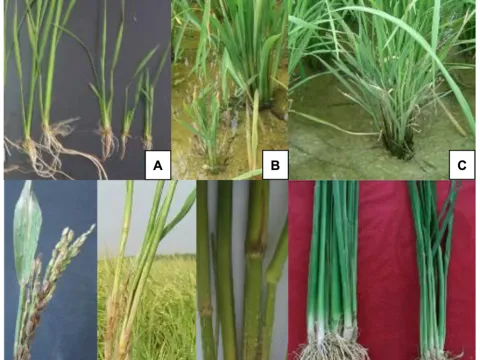
The most common symptom of RBSDV infection is stunting of the plant, which often results in a bushy appearance due to excessive tillering. Infected plants are significantly shorter than healthy ones.
A diagnostic sign is the presence of small, waxy, or whitish galls along the veins on the abaxial side of the leaf blades and on the leaf sheaths, which are characteristic of this specific viral infection.
Reproductive development is severely hampered. Panicles often fail to emerge fully from the boot leaf, and when they do, they are frequently empty or contain malformed, sterile grains.
Leaves of infected plants are typically darker green and stiffer than those of healthy plants. In severe cases, the entire plant structure becomes distorted, and leaf tips may show signs of yellowing or drying.
Because these symptoms can sometimes be confused with physiological disorders or other viral diseases, definitive diagnosis is typically performed using RT-PCR or ELISA testing.
Outbreaks are heavily influenced by the population dynamics of Laodelphax striatellus. High densities of these planthoppers during the susceptible seedling stage of the rice crop lead to increased infection rates.
Environmental conditions that favor the survival and breeding of the planthopper, such as mild temperatures and high humidity, indirectly facilitate the spread of the virus throughout the paddy fields.
The proximity of the rice fields to weeds and other susceptible grain crops provides a continuous source of inoculum, as the virus can circulate among these plants throughout the season.
Improper planting timing can be a critical factor. If the crop reaches its most vulnerable growth stage exactly when the migratory peak of the planthopper occurs, the impact of the disease is amplified.
Changes in local climate patterns, such as warmer winters, can lead to higher survival rates for overwintering planthopper populations, resulting in an earlier and stronger onset of the disease in the following spring.
RBSDV is considered a major threat to rice production in endemic regions. In severe cases of early infection, yield losses can range from 50% up to near-total failure of the crop.
Besides quantity, the quality of the harvested rice is significantly reduced. Grains are often underdeveloped, lightweight, and exhibit poor milling quality, rendering them less marketable.
Infected plants are physiologically weakened, making them more susceptible to secondary fungal or bacterial pathogens, which further diminishes the overall health of the field.
The economic burden extends beyond yield loss to the increased costs associated with repeated insecticide applications and the need for rigorous field monitoring.
In regions where rice is the primary staple and economic driver, RBSDV can disrupt food security and force farmers to abandon sensitive high-yielding varieties in favor of less productive but more tolerant ones.
The primary control strategy is the management of the planthopper vector. Systemic insecticides applied early in the growth cycle are effective in reducing the transmission of the virus.
Breeding and planting resistant or tolerant rice cultivars remains the most sustainable approach to managing the disease in endemic areas where chemical control is challenging.
Integrated pest management (IPM) practices, including weed management around field boundaries and optimizing planting schedules, help to disrupt the viral life cycle and reduce vector exposure.
The use of light traps and sticky boards for monitoring planthopper populations allows for timely intervention, ensuring that insecticides are applied only when necessary during peak migration times.
Regional cooperation and clean seed production practices help maintain healthy ecosystems, preventing the introduction or rapid spread of the virus into newly cultivated areas.