
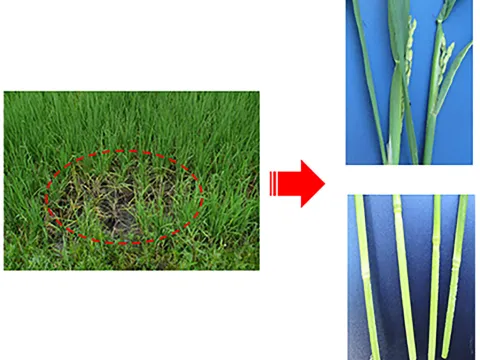
Rice black-streaked dwarf
Fijivirus boryzae
The disease is caused by the Rice black-streaked dwarf virus (RBSDV), scientifically classified as Fijivirus boryzae, which belongs to the Reoviridae family.
What the section contains
Rice black-streaked dwarf
This virus contains a segmented double-stranded RNA genome and is known for its ability to replicate within the vascular tissues of host plants.
It is an obligate parasite, meaning it depends entirely on host plants and its insect vectors to maintain its presence in the agricultural ecosystem.
Transmission of the virus is carried out by planthoppers, most notably the small brown planthopper (Laodelphax striatellus).
The virus follows a persistent, circulative, and non-propagative mode of transmission, meaning vectors remain infectious throughout their lifespan after acquiring the virus.
The hallmark symptom of the disease is severe stunting of the rice plant, caused by the shortening of internodes and leaves.
Dark, gall-like swellings or streaks appear on the lower surface of leaf blades and leaf sheaths, which eventually turn black as the plant matures.
Infected plants typically exhibit a deep green color, and their leaves may become stiff, twisted, and fail to unfold properly.
Many affected plants show reproductive failure, where the panicles remain trapped inside the leaf sheath or become severely deformed and sterile.
Root development is often suppressed, leading to a shallow root system that makes the plant highly susceptible to environmental stress and lodging.
Disease outbreaks are closely linked to the population dynamics of the vector, Laodelphax striatellus, which thrives in warm and humid conditions.
The presence of overwintering reservoir hosts, such as wild grasses and cereals in proximity to rice paddies, provides an early source of viral inoculum.
Weather conditions that favor the early migration of planthoppers significantly increase the likelihood of widespread infection in the field.
Excessive application of nitrogenous fertilizers can promote lush plant growth, making the crop more attractive to insect vectors and facilitating virus spread.
Continuous monoculture of rice in endemic areas allows for the persistent accumulation of the virus within the local environment, fueling recurrent epidemics.
Rice black-streaked dwarf is a major threat to global rice production, capable of causing yield losses ranging from moderate levels to total crop failure.
The damage is primarily manifested through significantly reduced grain filling, leading to low-quality, light-weight, or empty grains that are unsuitable for market.
High incidence rates necessitate expensive remediation efforts, such as replanting, which drastically increase the overall production cost per hectare.
The virus acts as a limiting factor for the adoption of high-yielding rice varieties, forcing farmers to select less productive but more tolerant alternatives.
Persistent outbreaks can lead to long-term economic instability for local farming communities, especially in regions heavily dependent on rice cultivation.
The primary control strategy involves the deployment of genetically resistant or tolerant rice varieties developed through modern breeding programs.
Effective management includes the use of systemic insecticides to suppress planthopper populations, particularly during the early vegetative growth stages of rice.
Cultural practices, such as removing weeds from field margins and bunds, help eliminate secondary hosts that sustain the virus during the off-season.
Strategic timing of planting is crucial to avoid the period of peak migration of insect vectors, thereby minimizing the exposure of vulnerable young seedlings.
Regular monitoring of vector populations in the field enables farmers to apply insecticides precisely when needed, preventing the escalation of viral transmission.