
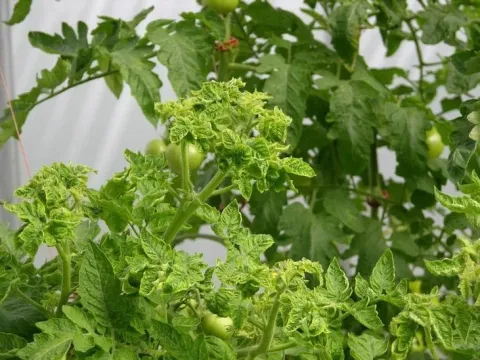
Tomato yellow leaf curl
Begomovirus solanumaureivariati
The causative agent of this disease is a group of viruses belonging to the genus Begomovirus within the family Geminiviridae. The most prominent species is the Tomato yellow leaf curl virus (TYLCV).
What the section contains
Tomato yellow leaf curl
This is a DNA virus that primarily affects solanaceous crops. Its viral genome is encapsulated in twinned particles, providing stability and infectivity in various host tissues.
The disease is classified as a systemic viral infection. Once introduced, the virus colonizes the phloem and translocates throughout the plant, causing major physiological disruptions.
The primary vector for transmission is the whitefly, Bemisia tabaci. The insect acquires the virus by feeding on infected phloem sap and remains a carrier for the rest of its lifespan.
Once ingested, the virus circulates within the whitefly's body, reaching the salivary glands, from which it is transmitted to healthy plants during subsequent feeding events.
Early symptoms typically appear on the youngest leaves of the plant. They show signs of chlorosis at the margins, become severely dwarfed, and start to curl upwards.
Plants affected by the virus exhibit significant stunting. Internodes become shortened, leading to a bushy, rosette-like appearance that is highly characteristic of the infection.
Flower production is severely disrupted; blossoms often abort or fail to set fruit. Any fruit that does develop is usually undersized, deformed, and of poor commercial quality.
Leaf texture becomes leathery and brittle. Veins may show chlorosis or even purpling, contributing to a mottled or mosaic-like appearance on the foliage.
- Upward curling and crinkling of leaves.
- Yellowing (chlorosis) of leaf margins.
- Severe growth stunting and bushy habit.
- Flower and fruit abscission.
Disease development is highly correlated with the presence and population density of the whitefly vector. Warm temperatures are ideal for whitefly reproduction and viral spread.
Greenhouses often provide optimal microclimates that allow whiteflies to thrive year-round, especially when weed hosts are present to serve as virus reservoirs.
The virus spreads most efficiently in areas where solanaceous weeds serve as an asymptomatic source of inoculum for newly planted tomato crops.
Human activities, such as the transport of infested seedlings or tools from infected areas to clean fields, significantly accelerate the geographic spread of the disease.
Conditions that favor rapid whitefly outbreaks, such as lack of moisture management or improper insecticide application, inevitably lead to massive viral incidence.
The damage caused by this virus is immense. If infection occurs early in the growth cycle, yield losses can range from significant reductions to a total crop failure.
The virus impairs essential physiological functions, including photosynthesis and nutrient transport. This leads to the total loss of marketable fruit and plant vigor.
Plants infected at the seedling stage rarely produce any harvestable yield, resulting in total economic loss for the producer and potential collapse of the farm's output.
Managing the disease incurs heavy costs related to intensive insecticide programs, which are required to suppress the vector populations throughout the season.
In endemic regions, the presence of the virus can restrict tomato production entirely, forcing growers to switch to resistant varieties or move crops to protected, insect-proof environments.
The most effective strategy is the use of resistant tomato cultivars. Breeding programs have successfully integrated resistance genes into many commercial hybrids.
Integrated Pest Management (IPM) is crucial. This includes using yellow sticky traps to monitor and reduce whitefly populations, as well as applying appropriate insecticides.
Sanitation is key; growers must remove and destroy infected plants and manage surrounding weed hosts to eliminate the virus reservoir in the environment.
For protected cultivation, the use of insect-proof netting with a small mesh size is a standard requirement to prevent whiteflies from entering greenhouses.
Strict phytosanitary protocols, including the use of virus-free nursery transplants and spatial isolation from older, potentially infected crops, are essential for prevention.