
Tomato yellow leaf curl virus
Begomovirus solanumflavi
Description
Symptoms
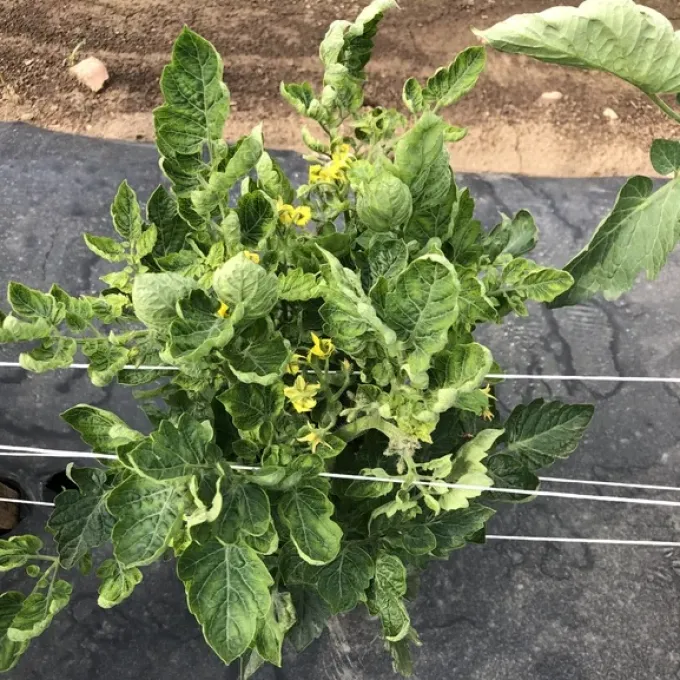
Initial symptoms include slight yellowing of the leaflet margins on the youngest leaves. The leaves become wrinkled, curled, and smaller than those of healthy plants.
Infected plants show severe stunting and reduced internode length, resulting in a bushy, rosette-like appearance of the top of the plant.
Flowering is often suppressed or, if flowers form, they frequently drop before fruit set. If fruits develop, they are usually small, malformed, and of poor quality.
The leaflets may become brittle and leathery. Sometimes, the undersides of the leaves exhibit a purplish discoloration due to the accumulation of anthocyanins.
The severity of symptoms depends on the age of the plant at the time of infection. Seedlings infected early in growth often fail to produce any marketable fruit.
Pathogen
The causative agent of the disease is the Tomato yellow leaf curl virus (TYLCV), which belongs to the genus Begomovirus within the family Geminiviridae. This virus contains a single-stranded circular DNA genome.
The virus is not transmitted mechanically by contact or through seeds. It is strictly transmitted by the silverleaf whitefly (Bemisia tabaci) in a persistent, circulative manner.
Once the whitefly acquires the virus by feeding on an infected plant, it remains a vector for the rest of its life. There is a short latent period before the insect can transmit the virus to a healthy plant.
Inside the host plant, the virus replicates in the nucleus of phloem cells. This systemic infection interferes with plant metabolism and hormone balance.
TYLCV is highly variable, with various strains exhibiting different degrees of virulence, making disease management challenging for breeders and growers alike.
Conditions for development
The development and spread of the disease are directly linked to the population dynamics of the whitefly vector. Warm temperatures (25–30°C) accelerate the whitefly life cycle.
Greenhouses and tunnels provide an ideal environment for whiteflies to thrive and for the virus to spread rapidly throughout the year, especially in tropical and subtropical regions.
Various weed species, particularly those in the Solanaceae family, act as reservoirs for the virus, allowing it to survive between cropping seasons.
Mass migration of whiteflies from open fields to protected structures in the autumn is a common trigger for severe outbreaks in late-season tomato crops.
Agricultural practices such as overlapping crop cycles without a host-free period significantly increase the risk of disease transmission and persistence.
Why it matters
TYLCV is considered one of the most economically damaging viral diseases for tomato production worldwide. Total yield loss can occur if infection happens at the seedling stage.
The infection significantly degrades the quality of the harvested fruit. Small, deformed, and improperly colored fruits have little to no commercial value in the fresh market.
The virus impacts the physiological ability of the plant to accumulate sugars and nutrients, leading to poor fruit flavor and texture.
The need for intensive insecticide application to control whitefly populations increases production costs and may lead to the development of insecticide resistance in the vector.
In regions where the virus is endemic, growers are often forced to abandon susceptible varieties, reducing the diversity of tomato products available.
Protection
Managing TYLCV requires an integrated pest management (IPM) strategy, focusing primarily on controlling the whitefly vector and minimizing the spread of the virus.
- Excluding whiteflies from greenhouses using fine-mesh insect-proof netting on all vents and openings.
- Implementing a strict host-free period to break the virus-vector transmission cycle.
- Monitoring whitefly populations using yellow sticky traps to time insecticide applications accurately.
- Using resistant or tolerant tomato hybrids that provide high levels of protection against TYLCV.
- Removing and destroying infected plants promptly to reduce the viral inoculum in the field or greenhouse.
Discussion
No discussions yet — be the first.