
Tomato yellow leaf curl virus
Begomovirus solanumflavusardiniaense
Description
Symptoms
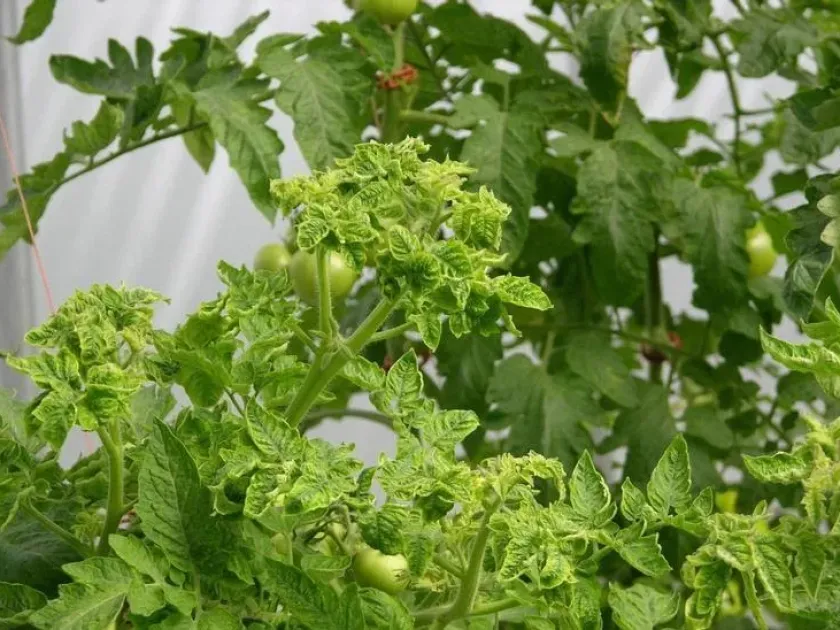
The first signs of TYLCV include the upward curling of leaf margins on the terminal growth. Young leaflets appear smaller, crinkled, and show a characteristic yellowing at the edges.
The plant exhibits severe stunting with shortened internodes, creating a bushy, stunted appearance. The development of the foliage becomes distorted and irregular.
Floral abscission is very common, often leading to a total loss of fruit set. If fruits do develop, they are typically undersized and may be deformed.
Symptoms are systemic; once a plant is infected, the virus spreads to all tissues, meaning the entire plant becomes a reservoir for the whitefly vector.
In mature plants, symptoms may be milder, but the reduced photosynthetic capacity and disrupted nutrient flow significantly decrease the overall yield and fruit quality.
Pathogen
The causative agent of the disease is the Tomato yellow leaf curl virus (TYLCV), which belongs to the genus Begomovirus within the Geminiviridae family. It is a virus with a circular single-stranded DNA genome.
The virus particles are geminate (twin) icosahedral structures. TYLCV is highly diverse, with various strains identified globally, differing in their virulence and host range adaptability.
The pathogen is not transmitted through seeds, pollen, or mechanical contact. It relies exclusively on an insect vector for dissemination, following a circulative-persistent transmission mechanism.
The primary vector is the sweet potato whitefly, Bemisia tabaci (biotypes B and Q). The whitefly acquires the virus by feeding on infected phloem tissue and can transmit it for the rest of its life after a latent period.
Once ingested, the virus moves through the insect's digestive tract into the hemolymph and eventually reaches the salivary glands, where it is injected into the vascular tissues of healthy plants.
Conditions for development
The spread of the virus is highly dependent on the population dynamics of Bemisia tabaci. High temperatures and dry conditions favor the rapid reproduction and migration of the whitefly.
In greenhouse environments, the virus can persist year-round if weed hosts, such as Solanum nigrum or Datura stramonium, are present to maintain the vector population.
The movement of the vector from outdoor crops into greenhouse facilities during warmer months is a primary route for introducing the infection into controlled environments.
Agricultural practices that promote high whitefly densities, such as insufficient sanitation or improper spacing, create an ideal environment for rapid disease outbreaks.
The global trade of ornamental plants and vegetable seedlings has also contributed to the spread of various virulent strains of the virus across different geographical regions.
Why it matters
TYLCV is considered one of the most economically devastating viruses affecting tomato production worldwide. Early-stage infection can result in 100% loss of harvest.
The infection severely limits the plant's ability to allocate resources to fruit development, as the energy is redirected to cope with systemic viral stress and tissue deformation.
Financial losses occur due to both the direct loss of fruit and the high costs associated with rigorous insect control programs needed to suppress the whitefly population.
The virus restricts cultivar selection, forcing growers to rely on a limited number of resistant varieties, which may not always meet specific market demands or local yield expectations.
Strict phytosanitary regulations regarding international plant movement often increase the administrative and operational burden on producers operating in affected regions.
Protection
The most effective strategy is the exclusion of the vector. Utilizing insect-proof greenhouses with 50-mesh screening on vents is critical to prevent whitefly entry.
Implementing a crop-free period helps to break the life cycle of both the virus and the vector. During this time, comprehensive sanitation, including the removal of all weeds, is essential.
Biological control agents, such as Eretmocerus eremicus or Amblyseius swirskii, can be used to manage whitefly populations within integrated pest management programs.
- Deploying tomato varieties with verified genetic resistance to TYLCV.
- Regular monitoring using yellow sticky traps to track whitefly population density.
- Applying systemic insecticides as part of a resistance management strategy.
- Eliminating potential weed hosts in the vicinity of the growing area.
- Ensuring that all seedlings are sourced from high-quality, virus-free nurseries.
Successful management requires a cohesive strategy that integrates physical exclusion, biological control, and chemical applications, while continuously monitoring for vector pressure.
Discussion
No discussions yet — be the first.