
Tomato yellow leaf curl Jeske virus
Begomovirus jeskei
Description
Symptoms
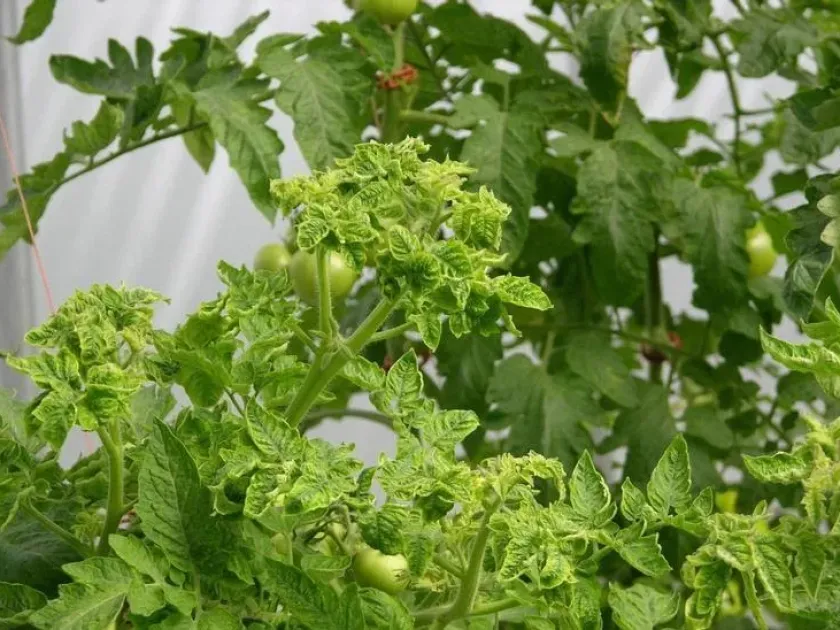
Initial symptoms are characterized by the upward curling of the leaflets on the terminal growth, which become smaller and wrinkled. The leaves often develop a crinkled or cup-shaped appearance.
A pronounced interveinal chlorosis develops, while the leaf veins remain a contrasting dark green. Over time, the entire leaf blade may become brittle and leathery.
Plants infected at an early stage exhibit severe stunting and reduced internode length. This often leads to a bushy, stunted appearance due to the proliferation of secondary shoots.
Flowering is heavily affected; buds frequently drop off or produce abnormal flowers. The fruit set is drastically reduced, and any resulting fruits are typically small and deformed.
The overall appearance of the plant becomes severely compromised, leading to a complete lack of vigor and an inability to perform standard physiological functions.
Pathogen
The causative agent of the disease is the Tomato yellow leaf curl Jeske virus (TYLCJV), a member of the genus Begomovirus within the Geminiviridae family. It is a single-stranded DNA virus with a significant potential for recombination.
This is a systemic viral disease that primarily targets the phloem tissue of the host plant, causing severe disruption in nutrient translocation. It does not possess the ability to be transmitted mechanically.
The virus relies exclusively on its vector, the silverleaf whitefly (Bemisia tabaci), for transmission. The virus is acquired by the insect through ingestion and is circulated within its system.
Once the whitefly is infected, it remains a vector for the duration of its lifespan. The virus does not propagate within the plant via contact or seeds, but only through the feeding action of the insect vector.
The geographical distribution of the virus is strictly tied to the presence of Bemisia tabaci, making it a significant concern in warmer climate zones globally.
Conditions for development
The primary factor for disease development is the density of the whitefly population. High whitefly pressure directly correlates with the rapid spread of the virus within a crop.
Optimal environmental conditions for the spread include warm temperatures, which facilitate faster maturation and reproduction cycles for the whitefly vector.
The presence of alternative host plants, particularly weeds within the Solanaceae family, provides a continuous reservoir of the virus even in the absence of commercial crops.
Agricultural practices such as overlapping crop cycles in greenhouses or the lack of fallow periods allow the virus and its vector to thrive throughout the entire year.
Poor spatial isolation between infested areas and new plantings often results in the immediate contamination of healthy crops by migrating whitefly adults.
Why it matters
The economic impact of the virus is catastrophic, as early-season infections can lead to a total loss of marketable fruit production in affected greenhouses or fields.
Farmers face significant financial burdens due to the constant need for intensive pest control programs aimed at suppressing the vector, which increases overall production costs.
The virus reduces the quality of the harvest, making the fruit unacceptable for premium retail markets due to their stunted size and lack of quality.
In regions where the virus is prevalent, producers may be forced to abandon certain tomato varieties, limiting the diversity and profitability of their agricultural production.
The overall weakening of plant health makes the crops more susceptible to secondary pathogenic attacks, further complicating the management of the crop health.
Protection
The most effective strategy for disease management is the exclusion of the whitefly vector. Fine-mesh insect-proof screening in greenhouses is the primary physical barrier used.
Implementing an Integrated Pest Management (IPM) program that utilizes biological control agents alongside judicious insecticide use can effectively maintain low whitefly populations.
Monitoring for the presence of adult whiteflies using yellow sticky traps is essential for making timely decisions regarding the deployment of protective measures.
Sanitation practices, including the removal of weeds around the growing area and the destruction of symptomatic plants, are crucial to minimize the spread of the inoculum.
The use of resistant or tolerant tomato hybrids is highly recommended in areas with endemic whitefly populations to safeguard crop yields and economic viability.
Discussion
No discussions yet — be the first.