
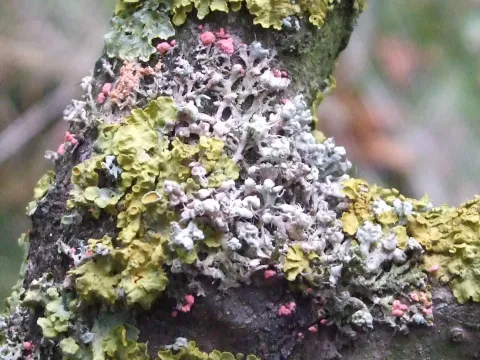
Ascending lichen
Physcia adscendens
Physcia adscendens, commonly known as the ascending lichen, is a species of foliose lichen belonging to the Physciaceae family. It is a symbiotic organism comprised of fungi and algae, growing as an epiphyte on the bark of trees.
What the section contains
Ascending lichen
It is not a parasitic disease or a fungal pathogen in the sense that it does not actively feed on the tree's internal vascular system or cause necrotic lesions in the wood.
The lichen uses the bark primarily as a physical substrate for anchor, gathering its nutrients and moisture directly from the atmosphere, rainfall, and airborne dust particles.
The thallus is characterized by lobes that rise from the bark, creating a distinct appearance often associated with "cilia" or marginal hairs at the edges.
While often ignored, its presence is a bio-indicator of the microclimate, typically appearing where moisture levels are high and light exposure is adequate for photosynthesis.
The most visible sign of Physcia adscendens is the presence of grayish or bluish-white scales or lobes that cluster together on the trunk or branches.
Look for curled-up lobe tips that are often hollow or bear soralia, which are powdery structures used for reproduction, giving the edges a swollen look.
These colonies are commonly found on the branches of older, slower-growing trees or in protected crotches where moisture lingers after rainfall.
During wet weather, the lichen appears more vibrant, often turning a greener or fresher gray, while in dry conditions, it becomes brittle and pale.
The distribution of the lichen can vary from small isolated patches to widespread coverage that obscures the natural texture of the bark.
High humidity and poor air circulation within the tree canopy are the primary drivers for the successful establishment of this lichen species.
Trees with rough or aging bark provide the most suitable surface area, allowing the lichen to grip and expand its colony over several seasons.
Light levels are crucial; while it prefers some exposure to light, it also thrives in semi-shaded areas where the bark stays damp for longer durations.
The lack of proper orchard management, particularly neglecting regular thinning and pruning, allows moisture to become trapped, facilitating lichen growth.
Environmental factors, including consistent rainfall and airborne nutrients, contribute to the density and health of the lichen population on affected hosts.
Although not a primary killer of trees, Physcia adscendens can harbor small pests like scales or aphids, protecting them from predators under the thick thallus.
Excessive lichen cover can trap excessive moisture against the bark, which may predispose the wood to fungal decay or bark splitting during freeze-thaw cycles.
The accumulation of lichen may slightly interfere with the bark's natural gas exchange processes, which is more detrimental to younger, sensitive saplings.
Its presence often signals that the tree is in a state of reduced vigor, potentially requiring better fertilization, irrigation, or overall systemic care.
Widespread coverage can hide the early symptoms of true tree diseases or mechanical wounds that require more urgent horticultural attention.
The most effective management strategy is to improve the tree's overall vigor through balanced fertilization and regular horticultural care.
Pruning is essential to remove overcrowded branches, which increases sunlight penetration and airflow, making the bark environment less hospitable to lichens.
Mechanical removal via soft-bristle brushing is highly effective for cleaning trunks without damaging the delicate underlying cambium layer.
Applying dormant season sprays, such as copper-based fungicides, can effectively reduce lichen populations while also cleaning the bark surface of other contaminants.
- Regular canopy thinning for better aeration
- Manual brushing of heavily affected branches
- Trunk whitewashing to improve bark sanitation
- Copper-based dormant sprays application
- Improving tree health through proper irrigation