
Arthrorhaphis citrinella
Arthrorhaphis citrinella
Description
Symptoms
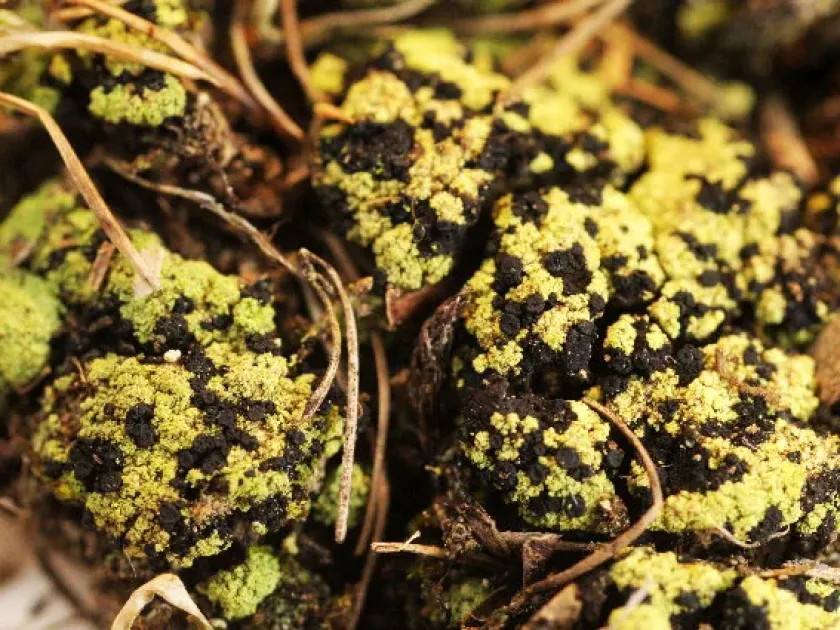
The most prominent sign is the appearance of bright, lemon-yellow or yellow-green crusty, granular patches on tree bark or rocky substrates.
The thallus is typically vibrant in color, distinguishing it from the more common grey or green-grey lichens found in the garden.
Small, blackish apothecia (fruiting bodies) may be visible embedded within the yellow granular mass of the lichen.
Unlike disease-related lesions, the bark remains firm and healthy underneath the lichen colony, without signs of rot or wood tissue disintegration.
The visual impact is limited to surface colonization, which often adds to the perceived age or maturity of the tree.
Pathogen
Arthrorhaphis citrinella is not a plant pathogen or a disease agent. It is a biological species belonging to the lichen group of organisms.
It consists of a fungal partner and a photobiont (alga), which coexist in a mutualistic relationship to form a distinct thallus.
The organism does not infect plant tissues, nor does it consume nutrients from the plant; it merely uses the bark as a physical substrate for growth.
In agronomy, it is crucial to classify Arthrorhaphis citrinella as an epiphyte rather than a disease, ensuring that unnecessary chemical treatments are avoided.
The lichen is completely independent of the plant's metabolic processes and plays no role in the development of crop diseases.
Conditions for development
This species thrives in environments with high air quality, as it is highly sensitive to pollutants and industrial emissions.
It prefers shaded or semi-shaded locations with high relative humidity, which are necessary for its slow growth and metabolic maintenance.
The lichen is commonly found on the rough bark of mature trees, where it has enough surface area to establish stable colonies.
Moderate temperatures during the growing season support the colonization process through the dispersal of fungal spores.
The lack of competitive pressure from other pioneer species allows Arthrorhaphis citrinella to occupy niche spots on long-lived trees.
Why it matters
Arthrorhaphis citrinella causes no damage to the host plant and does not impact agricultural productivity.
There is no evidence that this lichen interferes with tree growth, nutrient uptake, or the development of leaves and fruits.
While some lichen growth can indicate environmental humidity, this is an observation of the habitat, not a symptom of tree illness.
Farmers and gardeners should consider this organism as a natural part of the local ecosystem rather than a threat to their orchard health.
No economic damage is associated with this species, and it does not contribute to crop yield losses.
Protection
No control measures are necessary for Arthrorhaphis citrinella as it is not harmful to crops or garden plants.
If management is desired for aesthetic reasons, simple mechanical removal of loose, dead bark during dormant seasons is the safest approach.
Improving air circulation and pruning techniques can naturally manage the levels of moisture on tree trunks, potentially slowing lichen colonization.
Whitewashing trunks remains a preventative measure used in traditional horticulture to maintain clean bark surfaces on young trees.
- Mechanical cleaning of tree bark
- Proper garden maintenance and pruning
- Focus on plant vigor rather than lichen removal
Discussion
No discussions yet — be the first.