
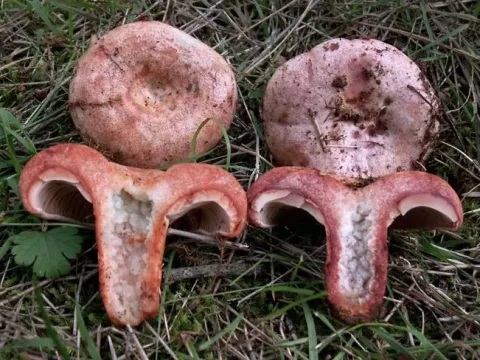
Bleeding milk cap
Lactarius sanguifluus
It is essential to clarify that Lactarius sanguifluus, commonly known as the Bleeding milk cap, is not a plant pathogen or a disease agent.
What the section contains
Bleeding milk cap
This organism is a macrofungus in the family Russulaceae, and it lives in a mutually beneficial relationship called mycorrhiza with tree roots.
In this symbiotic process, the fungus provides the tree with essential nutrients and water while receiving sugars from the tree's photosynthesis.
Because it is a symbiont and not a parasite, it does not infect or damage the tissues of healthy host plants in any way.
Therefore, classifying this fungus as a plant disease is scientifically incorrect and misleading for agricultural management.
The presence of this fungus is indicated by the growth of its fruiting bodies, typically found in pine forest floor litter.
The cap of the mushroom exhibits a distinctive wine-red or blood-red coloration, often displaying concentric zones as it matures.
The most diagnostic feature is the thick, dark red latex that exudes from the flesh when sliced or damaged, which darkens further over time.
The gills also have reddish tones and may develop greenish stains when bruised, which is a natural physiological process, not an infection symptom.
There are no symptoms like wilting, necrosis, or cankers on the associated trees that could be linked to this fungus.
The development of the fruit bodies is highly dependent on specific ecological conditions found in temperate conifer forests.
The fungus thrives in environments with high soil humidity and moderate temperatures, typically during late summer and autumn seasons.
A soil environment rich in organic matter and pine needles provides the ideal substrate for the growth of the fungal mycelium.
It shows a strong preference for calcareous soils and requires the presence of its host trees, primarily species of the Pinus genus.
Favorable rainfall patterns significantly trigger the emergence of mushrooms above ground, making them more visible after damp periods.
The Bleeding milk cap causes absolutely no harm to forestry, commercial crops, or ornamental plant health.
Instead, its symbiotic presence is highly advantageous, helping trees survive under various environmental stresses, such as drought.
Applying fungicides to eliminate such beneficial mycorrhizal fungi can inadvertently weaken the overall health of the tree plantation.
Destroying these fungi disrupts the delicate microbial balance of the soil, which is crucial for long-term ecosystem stability.
The fungus is widely valued as a premium edible species and serves as an important component of forest biodiversity.
There is no need for any control measures or protective strategies against Lactarius sanguifluus as it is not a pest or disease.
Agricultural and forest management practices should focus on maintaining natural soil health rather than attempting to eradicate beneficial fungi.
If mushroom growth is considered aesthetically undesirable in landscaping, improving soil drainage and aeration can naturally limit their emergence.
It is recommended to avoid unnecessary chemical applications that might affect the beneficial mycorrhizal network.
- Avoid the unnecessary use of systemic fungicides.
- Monitor tree health through regular visual inspection for actual pathogens.
- Preserve organic forest floor litter to support beneficial microbial life.