
Blood disease of banana
Pseudomas
The blood disease of banana is caused by the bacterium Ralstonia syzygii subsp. celebesensis. Previously, this pathogen was classified under the Pseudomonas genus, which is why older scientific literature often uses this name as a reference.
What the section contains
Blood disease of banana
It is a gram-negative rod-shaped bacterium that colonizes the vascular system of the banana plant. It primarily targets the xylem, where it multiplies and obstructs the transport of water and nutrients.
The bacterium is highly host-specific and has become a major threat to banana production in Southeast Asia. It can persist in soil and infected plant debris for significant periods.
The disease spreads via infected planting material, contaminated agricultural tools, and various insect pollinators that visit the banana flowers. Insects act as active vectors, moving the bacteria from diseased to healthy plants.
This is a systemic bacterial wilt. Once the infection enters the plant, it travels through the vascular bundles, leading to complete wilting and death of the plant within a few weeks.
The first symptoms are the yellowing and drooping of young leaves. As the infection progresses, the leaves turn brown and become dry, which is a common sign of systemic vascular failure.
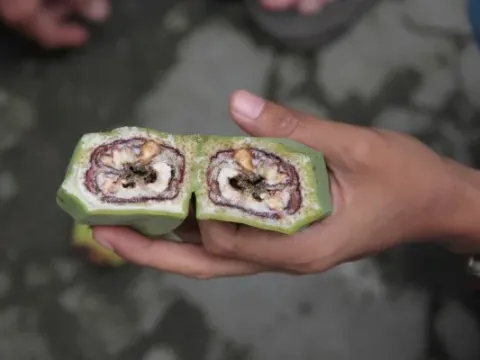
The most diagnostic feature is the presence of a rusty-red or brown exudate that oozes from the cross-sections of the pseudostem or the fruit stalk. This appearance gives the disease its common name.
Fruit development is severely impaired, and premature ripening often occurs. When the fruit is cut, the pulp displays characteristic reddish or rusty-colored patches, rendering it unmarketable.
The core of the pseudostem and the rachis show severe necrosis, turning dark brown or black. The tissue softens and emits a foul, rotting odor due to the disintegration of vascular elements.
Male buds fail to develop properly, becoming shriveled and blackened. The entire plant growth stops, and the root system begins to decay, eventually leading to the collapse of the plant.
The development of the pathogen is favored by high temperatures, typical of tropical regions. Temperatures between 25 and 30 degrees Celsius are optimal for bacterial proliferation.
High humidity and consistent rainfall contribute significantly to the spread of the disease. In these conditions, insect populations thrive and move frequently between plants, facilitating the transmission of bacteria.
Insect pollinators, particularly bees and thrips, are crucial in spreading the bacteria during the flowering period, as they move between male buds of infected and healthy plants.
Poor agricultural practices, such as failing to disinfect knives and tools used for desuckering or harvesting, are primary causes of mechanical spread across the plantation.
High planting density allows the bacteria to move easily through the soil and shared root systems, turning isolated infections into a widespread epidemic across the field.
Blood disease is one of the most destructive diseases in banana farming, with the potential to destroy 100% of the crop on an infested plantation within a single season.
The infection causes total loss of fruit quality, making it unsuitable for local markets or export. Because bananas are propagated vegetatively, infected mother plants pass the disease to all suckers.
The economic impact is massive, involving the cost of plant removal, loss of income, and the implementation of expensive quarantine measures to contain the outbreak.
In infested areas, banana production becomes economically non-viable, threatening the livelihood of smallholder farmers and regional food security.
Due to the lack of resistant commercial varieties and effective chemical treatments, management relies heavily on strict sanitation and the immediate destruction of affected plant material.
Strict phytosanitary control is the first line of defense. The movement of planting material from infested zones to clean regions must be strictly prohibited.
Disinfection of all tools is mandatory. Workers must sanitize their knives using appropriate disinfectants after every contact with a banana plant to prevent mechanical spread.
Any plant showing symptoms must be immediately rogued, including the rhizome, and destroyed by burning on-site to minimize the bacterial inoculum load.
Managing insect populations during the flowering period can help reduce the frequency of flower-to-flower transmission of the bacteria.
- Regular monitoring and scouting of plantations for early detection.
- Ensuring the use of certified disease-free planting material.
- Elimination of wild banana relatives that might serve as a reservoir for the bacterium.