
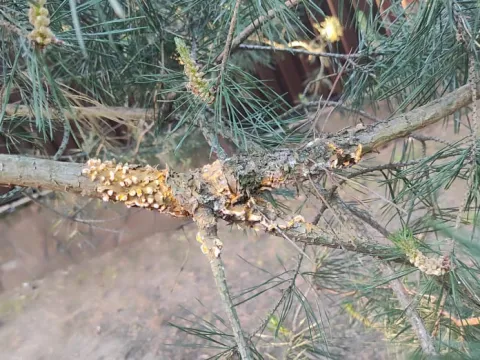
Blister rust
Cronartium flaccidum
The causative agent of the disease known as blister rust is the rust fungus Cronartium flaccidum. It is an obligate parasite that specifically targets coniferous trees, particularly pines.
What the section contains
Blister rust
This pathogen requires two different hosts to complete its complex life cycle. Pines act as the primary host, where the fungus causes stem and branch infections that develop over many years.
Intermediate hosts include various herbaceous plants, such as certain species of Vincetoxicum, Pedicularis, or Paeonia. The fungus alternates between these hosts to produce different spore stages.
The mycelium of the fungus is perennial, meaning it survives within the host tree for several years. It continuously grows through the inner bark and cambium, progressively causing more damage.
Fungal infection disrupts the tree's vascular system, hindering the transport of water and nutrients. Over time, this systemic infection leads to the decline and eventual death of the host tree.
Early symptoms appear as subtle swellings or localized thickenings on the bark of trunks or branches. These areas often darken as the fungus establishes itself deep within the tissue.
During the spring, the characteristic aecia appear. These are bright orange to yellow blisters that erupt through the bark, releasing large quantities of fungal spores into the air.
Following the release of spores, the ruptured bark leaves behind distinct, resinous wounds. These open sores serve as entry points for secondary pathogens and wood-boring insects.
Chronic infections lead to deep cankers and necrosis. The trunk may become severely deformed or exhibit abnormal growths as the tree attempts to wall off the fungal infection.
Severe branch or stem girdling results in the death of the upper canopy parts. The needles turn yellow and brown, eventually shedding, signaling that the branch is no longer receiving nutrients.
The development of the disease is heavily influenced by climatic factors, particularly moisture. High humidity and cool temperatures in spring provide ideal conditions for spore germination.
Poor air circulation in dense forest stands creates a microclimate that favors fungal survival. Low light and high moisture levels under the canopy allow spores to persist longer.
The proximity of the primary host to intermediate host plants significantly increases the risk of infection. Effective spore transmission relies on these reservoirs of the fungus present in the undergrowth.
Trees experiencing environmental stress, such as poor soil quality or drought, are more susceptible to infection. A robust immune system is crucial for a tree to resist the initial colonization.
Wind acts as the primary vector for spore dispersal, allowing the disease to spread across large distances. Even isolated forest stands can become infected if environmental conditions are right.
Blister rust is a devastating disease in commercial forestry, as it leads to significant losses in timber quality and volume. It is capable of destroying entire young stands.
Timber from affected trees is often structurally compromised. Cankers and resinous areas render the wood unsuitable for construction or high-quality wood processing industries.
Infected trees often serve as breeding grounds for secondary pests like bark beetles. The combination of fungal damage and insect attack significantly accelerates the mortality of forest stands.
Financial losses occur due to reduced growth rates, mandatory salvage logging, and the high costs associated with replanting and monitoring forest health.
The disease also poses ecological risks by altering forest structure and species composition. The loss of pine stands can negatively impact local biodiversity and wildlife habitats.
Integrated forest management is the most effective approach to control blister rust. This includes regular surveillance to detect and remove infected trees early in the process.
Sanitation cuttings are essential. All infected branches or entire trees must be removed from the forest and burned to eliminate the source of further spore production.
In nurseries, prophylactic application of fungicides is a standard practice to protect young seedlings. Systemic fungicides help prevent the establishment of the fungus in vulnerable stages.
Silvicultural strategies, such as thinning stands to improve airflow and selecting resistant pine genotypes, are crucial for long-term prevention and control.
Managing the understory to reduce the population of intermediate hosts can decrease the local infection pressure. A diverse, well-maintained forest ecosystem is more resilient to rust diseases.