
Bloody brittlegill
Russula sanguinaria
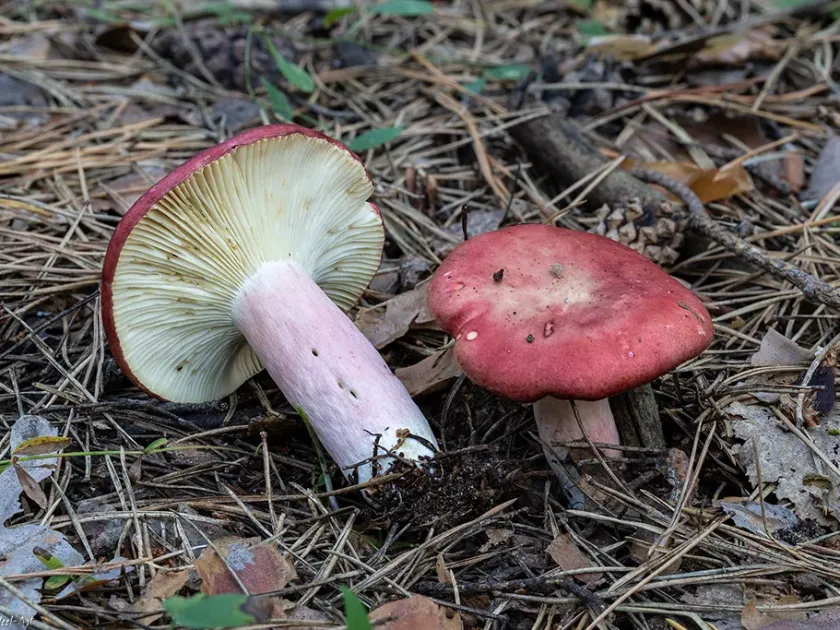
Description
Pathogen
It is important to clarify that the Bloody brittlegill (Russula sanguinaria) is not a plant disease or a pathogen. It is a fungus of the Russulaceae family that primarily exists in a mycorrhizal relationship with trees.
This organism is a saprotrophic and mycorrhizal species that does not parasitize agricultural crops. It lacks the biological mechanisms to invade plant tissues and cause diseases.
The fungus forms symbiotic bonds with the root systems of trees, specifically conifers like pine. This connection is vital for the exchange of nutrients between the fungus and the host tree.
From an agronomic perspective, Russula sanguinaria is classified as a forest fungus rather than a crop pest or a disease agent.
Labeling this species as a plant disease is factually incorrect and misrepresents its ecological function in the soil environment.
Conditions for development
The development of Russula sanguinaria fruiting bodies is strictly limited to coniferous and mixed forest ecosystems where the tree host is present.
High humidity and moderate temperatures during the late summer and autumn are the primary environmental triggers for the emergence of the mushrooms.
The fungus thrives in acidic, nutrient-poor soil conditions often found in sandy forest habitats, which differ significantly from fertile agricultural fields.
Soil disturbance and intense agricultural practices typically inhibit the growth of this fungal species as they disrupt the mycorrhizal network.
Without the presence of specific forest trees, the fungal mycelium cannot survive or reproduce, preventing its colonization of agricultural land.
Why it matters
The Bloody brittlegill does not cause any harm to agricultural crops. It does not compete with plants for nutrients, nor does it destroy plant structures.
No economic damage to harvests is associated with this fungus. It serves no role as a vector for plant diseases or agricultural infections.
There are no recorded instances of this fungus affecting the yield or quality of crops like wheat, corn, or vegetable varieties.
Misidentifying this fungus as a plant disease is a significant diagnostic error that could lead to unnecessary and harmful pesticide use.
The fungus is a natural component of the forest soil ecosystem and has no impact on the health of crops in nearby fields.
Protection
No protective or control measures are necessary against Russula sanguinaria as it poses no threat to crops.
The use of fungicides to control this species is strongly discouraged because it disrupts the beneficial biodiversity of the soil.
Control efforts should be focused on actual pathogens that threaten agricultural productivity, rather than non-pathogenic forest fungi.
The best management practice is to allow this species to function within its natural ecological niche without intervention.
Agronomists are encouraged to monitor field conditions properly to distinguish between natural fungal presence and true phytopathological threats.
Discussion
No discussions yet — be the first.