
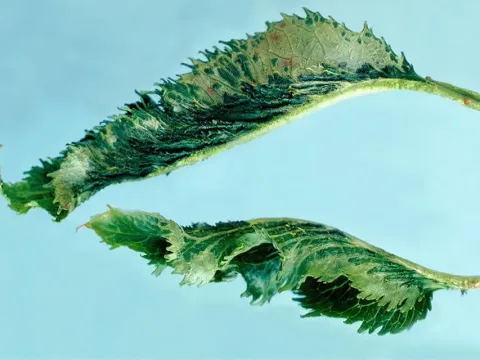
Cherry rasp leaf
Cherry rasp
The causative agent of the disease is the Cherry rasp leaf virus (CRLV). It is a plant pathogen that infects a wide range of woody species, including stone and pome fruits, belonging to the nepovirus group.
What the section contains
Cherry rasp leaf
The virus consists of particles with a single-stranded RNA genome. It spreads systemically through the plant's vascular system, penetrating phloem and xylem tissues, which leads to metabolic disruptions and deformation of plant organs.
In nature, wild species serve as the main reservoir for the infection, capable of harboring the virus for long periods. The pathogen can be transmitted via grafting material or through specific soil-borne vectors.
The biology of the virus is closely tied to the activity of soil-dwelling nematode vectors, which are the key link in the spread of the disease across apple and cherry plantations.
The virus also exhibits a high degree of variability, which complicates the development of resistant varieties of domestic apple trees and makes breeding efforts extremely challenging.
The first and most noticeable sign of the disease is a pronounced deformation of the leaf blade. Leaves become small, narrow, with characteristic uneven, often serrated margins, resembling a «rasp» or rough texture.
Significant shortening of shoot internodes is observed, causing the tree crown to take on an unnatural «flat» or flattened shape, which gave the disease its common name.
During the flowering and fruiting period, infected apple trees form significantly fewer blossoms. Fruits develop as small, deformed specimens, losing their varietal flavor qualities and having an unattractive market appearance.
A characteristic symptom is also the development of enations — specific outgrowths on the underside of the leaf, which look like small combs or warty formations.
The overall condition of the tree gradually declines: premature yellowing of the leaves, partial dieback of terminal shoots, and a reduction in the overall cold hardiness of the plant occur.
The spread of the virus in orchards occurs primarily through the use of infected grafting material taken from diseased mother plants during propagation.
A critical factor in the transmission of the disease in the soil is the presence of nematodes of the genus Xiphinema, which feed on the roots of infected plants, acquire the virus, and then transmit it to healthy trees.
Favorable conditions for the vectors include sufficient soil moisture and moderate temperatures, which facilitate their active movement within the root zone of the trees.
The development of the disease is exacerbated by intensive orchard management, where crop rotation is ignored and there is no monitoring of soil for harmful nematodes before establishing new orchards.
The virus can persist in the soil for several years even after the removal of diseased trees if live roots containing particles of the pathogen remain in the ground.
The main damage consists of a sharp decline in the productivity of affected plantations. Fruit-bearing trees eventually stop producing high-quality yields entirely.
The disease causes premature aging and gradual death of the tree, requiring early grubbing and removal of entire orchard sections, causing significant economic losses to the farm.
Infected plants become extremely sensitive to other stress factors, including drought, frost, and secondary fungal infections that easily attack the weakened tissues.
The damage also manifests in the inability to use scions from diseased trees for further propagation, leading to the loss of valuable varietal germplasm.
The spread of the virus in nurseries jeopardizes the quality of all planting material, making it impossible to sell saplings or obtain proper product certification.
The primary control method is the use of exclusively healthy, certified planting material that has been verified for the absence of viral infections in specialized laboratories.
Regular phytosanitary monitoring of the orchard is necessary, with mandatory removal and immediate destruction (burning) of diseased trees, including their root systems.
An effective measure is the control of nematode vectors through the application of appropriate nematicides or steam treatment of the soil before planting new crops.
- Use of apple varieties with increased tolerance to the virus.
- Adherence to quarantine regulations when importing nursery stock.
- Disinfection of pruning tools after working on each individual tree.
It is important to maintain spatial isolation between new young orchards and older, potentially infected areas to minimize the risk of infection spread by vectors.