
Onion panicle
Pantoea allii
Pantoea allii is a Gram-negative bacterium that belongs to the family Erwiniaceae and is recognized as a significant pathogen affecting Allium species.
What the section contains
Onion panicle
It is closely related to other Pantoea species but exhibits distinct genetic and phenotypic characteristics that specifically facilitate the infection of onion tissues.
The bacterium is highly motile due to its flagella, allowing it to navigate through water films and penetrate the host plant's internal structures.
It can persist in the environment, surviving on crop residues, in seeds, and within the soil, serving as a continuous source of inoculum for subsequent seasons.
The pathogen utilizes specific cell-wall degrading enzymes to break down plant tissues, facilitating its rapid spread within the bulb after the initial entry.
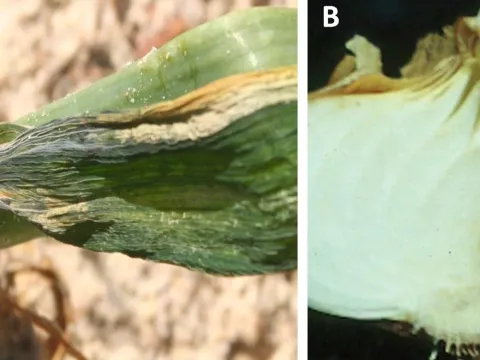
Symptoms of Pantoea allii infection are often subtle during the growth phase, manifesting as general chlorosis or yellowing of the leaf tips.
Internal symptoms become most apparent when cutting open a bulb, which reveals water-soaked and discolored scales, typically appearing translucent or light brown.
In advanced stages of the disease, the infected scales become soft and may disintegrate into a mushy consistency, emitting a sour, unpleasant odor.
The neck of the onion bulb is a primary point of entry, often appearing soft, sunken, or watery long before the rot spreads to the entire bulb.
Under humid conditions, a sticky, bacterial exudate may be visible, which contains high concentrations of the pathogen, ready to be spread by insects or water splashes.
The development of Pantoea allii is heavily dependent on high moisture levels and warm temperatures, specifically in the 25°C to 30°C range.
Field conditions with frequent rainfall during the maturity stage create an ideal environment for the bacteria to colonize the neck and upper scales of the bulb.
Mechanical injuries caused by harvesting equipment, insect feeding, or hail damage provide easy access points for the bacteria to enter the plant tissue.
Post-harvest practices, such as inadequate curing or drying of the onion crop, are critical factors that allow the bacteria to transition into an aggressive rot phase.
Poor ventilation and high humidity within storage facilities significantly accelerate the spread of the disease from infected bulbs to healthy ones in the same bin.
The primary harm caused by Pantoea allii is substantial post-harvest loss, which can render entire batches of onions unsellable.
Infected bulbs lose their market value, leading to significant economic losses for producers and distributors who face high culling rates.
The latent nature of the infection means that bulbs appearing healthy at harvest may develop severe rot during transit or storage, causing logistical failures.
It negatively impacts the reputation of the farming operation, as customers receive spoiled product despite initial grading efforts.
Large-scale outbreaks can force farmers to dispose of large quantities of produce, leading to waste management costs and the need to sanitize all storage infrastructure.
The primary control strategy is the use of high-quality, certified, and disease-free seeds or sets to ensure a clean start for the growing season.
Practicing long crop rotations (at least 3 years) helps reduce the population of the pathogen in the soil and interrupts its survival cycle.
Effective water management, particularly avoiding excess irrigation as the onions reach maturity, helps in hardening the neck tissues and preventing rot entry.
Optimized curing processes, where bulbs are dried rapidly and thoroughly with forced air, are essential to seal the neck and prevent bacterial penetration.
- Integrated pest management to control insect vectors.
- Sanitizing storage facilities and equipment before the new harvest.
- Avoiding harvest during wet, rainy weather.
- Regular monitoring of stored onions for signs of decay to prevent spread.