
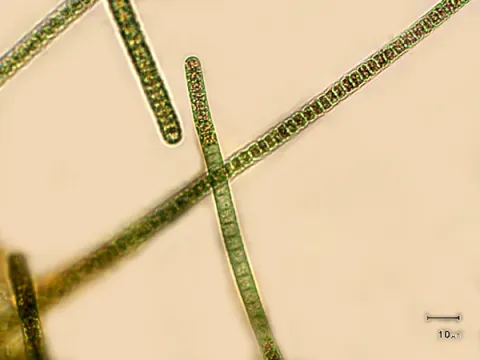
Oscillatoria princeps
Oscillatoria princeps
Oscillatoria princeps manifests as dense, slippery mats of dark green, bluish, or olive color on the surface of moist substrates or in hydroponic solutions.
What the section contains
Oscillatoria princeps
When seedlings or ornamental plants are affected, a characteristic musty or earthy odor is often detected emanating from the root zone of the plants.
Filamentous colonies of the organism can completely cover the soil surface in pots, preventing proper gas exchange and oxygen access to plant roots.
In the early stages, the colonies appear as thin films that thicken over time and begin to peel off, forming large floating or sinking masses.
Visually, the affected areas of the substrate appear waterlogged or covered in slime, which is often mistaken for overwatering, although it is a result of cyanobacterial growth.
The pathogen is Oscillatoria princeps, a type of filamentous cyanobacterium capable of active gliding movement and photosynthesis in moist environments.
The organism is a prokaryote, lacking a defined nucleus but possessing a sophisticated mechanism for atmospheric nitrogen fixation and the production of bioactive compounds.
These cyanobacteria are capable of surviving in extreme conditions by entering a dormant state when moisture is scarce and rapidly reactivating when conditions improve.
The biology of this species is closely linked to aquatic environments, making it a common problem in greenhouse operations that utilize hydroponics or overhead irrigation.
Propagation occurs through the fragmentation of filaments (trichomes), which are easily dispersed by water droplets or contaminated tools, rapidly colonizing new areas.
A key factor for development is excessive lighting combined with high humidity in the air and substrate, creating an ideal environment for phototrophic organisms.
Accumulation of excess phosphorus and nitrogen in nutrient solutions triggers cyanobacterial blooms and their rapid spread over the surfaces.
Poor ventilation and stagnant air in greenhouses contribute to increased soil surface moisture, which accelerates the formation of dense bacterial mats.
The temperature range between 20 and 30 degrees Celsius is optimal for the intensive cell division of Oscillatoria princeps.
Stagnant conditions in irrigation systems and a lack of circulation in hydroponic reservoirs create a favorable microclimate for colonization by this organism.
The primary damage lies in the creation of a physical barrier on the soil surface, which blocks oxygen intake to roots, causing gradual suffocation.
During their life cycle, these cyanobacteria can release specific toxins that negatively affect the development of seedlings and sensitive plant species.
The slime produced by the colonies alters the pH balance of the nutrient solution, leading to the disruption of mineral uptake by plants.
Massive algae growth ruins the aesthetic value of the product, which is particularly detrimental when growing ornamental plants in pots and containers.
Infestation can lead to the total loss of seedlings due to root rot, which is often exacerbated by the disruption of water and air regimes.
The first line of defense is optimizing light conditions and using light-proof materials for containers, reservoirs, and piping to prevent algae growth.
It is necessary to strictly monitor the concentration of nutrient elements in solutions, avoiding their excessive accumulation in the growing substrate.
Improving greenhouse ventilation and regular air circulation helps lower surface moisture and prevents the growth of cyanobacterial mats.
If hydroponic systems become infested, a complete disinfection of equipment with algaecides approved for use in protected cultivation is recommended.
- Ensuring aeration of the nutrient solution.
- Mechanical removal of the affected top layer of soil.
- Adherence to strict sanitation protocols for seedling care.