
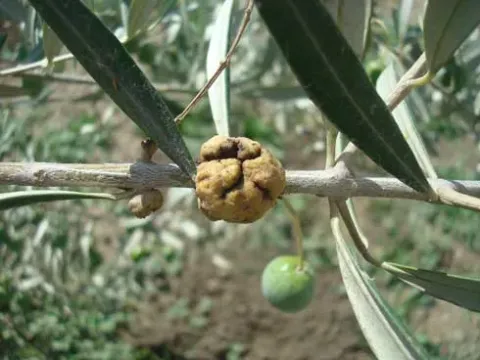
Olive knot
Pseudomonas savastanoi
Olive knot is caused by the bacterium Pseudomonas savastanoi, a plant pathogen that specifically infects olive trees and a narrow range of other woody hosts such as oleander.
What the section contains
Olive knot
The pathogen is a gram-negative rod that thrives by colonizing the plant tissue, particularly the cortex, and secreting proteins that trigger the formation of hyperplastic growths.
It does not produce spores, meaning the bacterium relies on passive transport via water droplets, wind-driven rain, or contaminated pruning tools to move from one host to another.
Once inside the plant, the bacteria inhabit the intercellular spaces and can survive in the knots for extended periods, serving as a permanent source of inoculum.
The disease is highly contagious and spreads rapidly within an orchard if sanitary protocols are not strictly maintained, especially during wet seasons.
The most distinctive symptom of the disease is the development of rough, tumor-like galls or "knots" on the branches, twigs, trunk, and sometimes on leaf petioles or roots.
Initially, these knots appear as small, smooth green swellings on the bark, but as they grow, they turn dark brown, hard, and develop a cracked, woody texture.
During periods of high humidity, the bacteria are released from these knots as a slimy exudate, which can then be spread by rainfall to nearby healthy tissue.
As the infection progresses, leaves may turn yellow (chlorotic) and drop prematurely due to the interference of the knots with the plant's vascular transportation.
In severe cases, the affected limbs may become brittle and break under their own weight or wind pressure, while the overall tree vigor significantly declines.
The development of Pseudomonas savastanoi is heavily dependent on moisture and moderate temperatures, typically favoring conditions between 15°C and 25°C.
Rainfall is the most important factor for dispersal; it washes the bacteria from existing knots and spreads them to new entry points such as pruning wounds or frost cracks.
Orchards located in areas with frequent fog, heavy dew, or prolonged spring rains are at a higher risk of epidemic outbreaks compared to dry, arid regions.
Wounds caused by mechanical harvesting, pruning, or weather-related damage are the primary entry sites for the bacteria, and these wounds remain vulnerable for several days.
High nitrogen fertilization can lead to excessive, tender vegetative growth, which is often more susceptible to infection and more prone to cracking during cold weather.
The disease leads to significant yield losses as the bacteria disrupt nutrient and water flow, causing the tree to invest energy into forming galls rather than producing olives.
Long-term infections can weaken the structural integrity of the tree, resulting in dieback of branches and, in extreme cases, the total death of the tree.
Olive knot is considered a quarantine concern in many parts of the world, posing trade barriers for nurseries and farmers who intend to ship plant material.
The aesthetic value of olive trees is severely compromised, which can be detrimental to orchards that rely on tourism or landscape value in addition to fruit production.
The cost of managing the disease, including continuous pruning and chemical applications, significantly increases operational expenses and reduces orchard profitability.
Management starts with strict nursery hygiene; only certified disease-free saplings should be used for establishing new olive orchards to prevent the introduction of the pathogen.
Pruning tools must be thoroughly disinfected with appropriate agents like copper-based solutions or alcohol after working on each tree to prevent cross-contamination.
If knots are identified, they should be surgically removed by pruning the branch several centimeters below the visible growth, followed by immediate sanitization of the wound.
Preventive copper-based sprays are widely used to create a chemical barrier on the surface of the bark, particularly after events like pruning, hail, or autumn rains.
- Use resistant or less susceptible olive cultivars.
- Avoid excessive nitrogen fertilizer application.
- Burn or remove all infected prunings from the orchard.
- Control insect pests that may cause bark damage.
- Ensure proper spacing to improve air circulation.