

Description
Symptoms
The first symptoms typically appear as dark brown streaks or necrotic lesions on the coleoptile and roots of seedlings, often leading to pre-emergence or post-emergence damping-off.
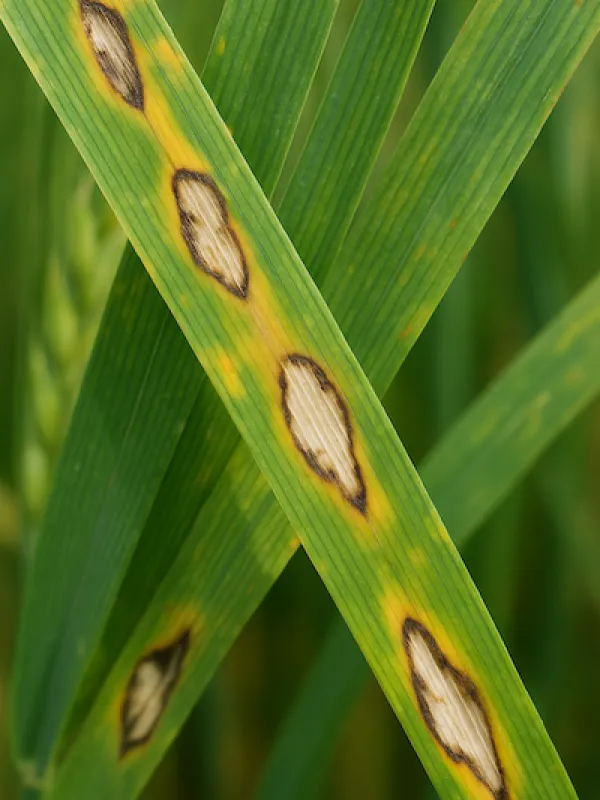
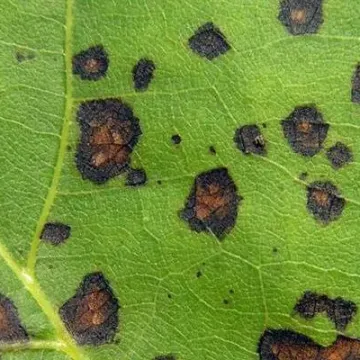
On leaves of adult plants, lesions appear as elongated or oval dark brown spots, often surrounded by a chlorotic halo that eventually merges with other spots to cover large leaf areas.
Under high humidity conditions, a dark olive-colored mold develops on the surface of the lesions, which is the massive conidial sporulation of the fungus.
In the heads of cereals, the disease manifests as black point discoloration at the base of the grain, commonly known as "black germ," which drastically reduces seed quality.
Severe infection leads to premature yellowing, drying, and death of leaves, starting from the lower canopy, which significantly limits the plant's photosynthetic capacity.
Pathogen
The causative agent of dark brown spot is the fungus Bipolaris sorokiniana (teleomorph Cochliobolus sativus), a versatile pathogen known to infect a wide range of monocotyledonous crops.
This pathogen survives in the soil as mycelium and conidia, in crop debris, and is also seed-borne, which makes it highly persistent within agricultural environments.
The fungus produces asexual spores (conidia) that are easily disseminated by wind, rain splashes, and insects, facilitating rapid infection spread across fields during the growing season.
Bipolaris sorokiniana secretes specific enzymes and phytotoxins that degrade plant cell walls, allowing the mycelium to penetrate deeper into host tissues and establish systemic infection.
The fungus is characterized by its ability to remain viable in the soil for several years, posing a significant challenge for growers who do not implement long-term crop rotation strategies.
Conditions for development
The development of dark brown spot is most favored by high humidity (above 80%) and moderate temperatures ranging from 20°C to 25°C, providing an ideal environment for spore germination.
Stressed crops, particularly those suffering from nutrient deficiencies like low potassium levels, are significantly more susceptible to the fungal invasion compared to healthy, well-fertilized plants.
Poor aeration in dense stands creates a microclimate with high moisture accumulation, which acts as a catalyst for the rapid spread of the disease within the crop canopy.
Prolonged wet periods, particularly during the heading and grain-filling stages, increase the risk of massive secondary infections affecting the spikelets and flag leaves.
Inadequate soil preparation and sowing under unfavorable moisture conditions can delay seedling emergence, making young plants vulnerable to initial colonization by the soil-borne pathogen.
Why it matters
Dark brown spot is considered a major limiting factor in cereal production, capable of causing significant yield losses ranging from 20% to 40% in highly susceptible varieties.
The primary economic impact results from the reduction in grain weight and quality due to compromised photosynthesis and the detrimental effect of "black point" on seed marketability.
Seed-borne infection reduces germination energy and seedling vigor, leading to poor stand establishment and an increased requirement for costly replanting in subsequent seasons.
The disease contributes to increased lodging and stalk breakage, which can complicate mechanical harvesting and increase total losses during the collection process.
Furthermore, the presence of fungal toxins can lower the nutritional and technological value of the grain, negatively impacting its utility in food and feed industries.
Protection
The most effective management approach involves a combination of seed treatment with systemic fungicides and the use of resistant or tolerant crop varieties.
Implementing a diverse crop rotation that avoids cereal crops for several consecutive years is critical to reducing the soil-borne inoculum pressure of the fungus.
- Thorough incorporation of crop residues into the soil.
- Application of balanced fertilizers to strengthen immunity.
- Weed control to eliminate alternative pathogen hosts.
- Adjusting sowing dates to avoid favorable infection windows.
Foliar fungicide applications during the growing season are recommended when weather conditions are favorable for disease development and the threshold for infestation is reached.
Proper field sanitation, including the removal of infected debris and the use of certified healthy seeds, remains the cornerstone of integrated disease management programs.
Reference
Connections · Dark brown spot
Most often together:
Pests
1 contact
Marketplace
Products · 99








Community
Discussion
No discussions yet — be the first.