
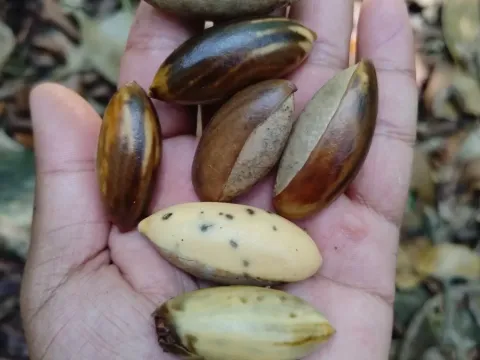
Palaquium ellipticum
Palaquium ellipticum
Palaquium ellipticum is a significant tree species belonging to the Sapotaceae family, native to the tropical rainforests of the Western Ghats in India. It is a large evergreen tree that thrives in warm, humid climates where annual precipitation is high and temperature fluctuations are minimal. The species is a hallmark of the dense, biodiverse canopy layer of its native environment.
What the section contains
Palaquium ellipticum
The culture requires deep, well-drained, and nutrient-rich soils to support its substantial biomass accumulation. Waterlogging is detrimental to the development of the root system, as the species requires aerobic soil conditions to maintain metabolic functions. The plant generally prefers sheltered locations that provide a degree of protection from excessive direct solar radiation during its juvenile stages.
Botanically, the species is recognized by its dense, elliptical, coriaceous leaves and a trunk that yields a milky latex containing gutta-percha. The growth rate is characteristically slow, which contributes to the formation of high-density wood fibers. Its canopy provides essential shade, maintaining a stable microclimate for numerous epiphytes and understory plants within its habitat.
In terms of хозяйственное использование, the primary value lies in its high-quality timber, which is appreciated for its hardness, durability, and resistance to environmental decay. It is widely used in high-end joinery, construction projects, and specialized industrial applications. The latex extracted from the bark has also historically been significant for insulation and medical purposes.
Cultivation practices focus on nursery propagation and careful reforestation management. Seeds should be sown shortly after collection, as they exhibit recalcitrant properties. Agronomic management involves maintaining soil moisture levels, monitoring sapling health, and thinning competing vegetation to ensure adequate nutrient and light availability for the developing trees.
The primary threats include fungal pathogens affecting the root system, particularly in poorly drained environments, and various wood-boring insects that target the mature trunk, compromising the timber quality. Habitat fragmentation due to deforestation remains the most significant threat to its natural regeneration and genetic diversity, necessitating controlled forestry management.