
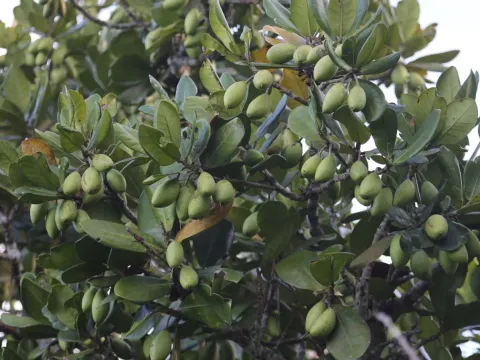
Palaquium
Palaquium
Palaquium is a genus of tropical trees belonging to the Sapotaceae family, native to Southeast Asia, particularly Malaysia and Indonesia. These trees are historically significant for the production of gutta-percha, a natural, rigid latex.
What the section contains

Palaquium
The crop thrives in humid, tropical climates characterized by high rainfall and consistently warm temperatures. They are strictly equatorial plants and cannot tolerate frost or significant temperature fluctuations during the growing season.
Ideal soil conditions include deep, well-draining, and nutrient-rich tropical soils. Proper water management is essential; while the tree requires significant moisture, waterlogging must be avoided to prevent root diseases.
Agronomic practices for Palaquium involve careful site selection within forest margins or dedicated plantations. The trees require substantial space to develop their canopy, making initial planting density a critical factor for long-term productivity.
Propagation is typically achieved through seeds or vegetative cuttings in nursery settings. Seedlings benefit from shade during their juvenile phase, which helps mimic the natural light conditions of the forest floor.
The primary economic product of the Palaquium tree is gutta-percha, which is collected from the milky sap. Harvesting involves making careful incisions in the bark to extract the latex without endangering the tree's survival.
Historically, the leaves and branches were also harvested and processed to extract the valuable polymer. Gutta-percha is highly prized for its unique dielectric properties, making it an excellent natural electrical insulator.
Modern applications of gutta-percha include dentistry, where it is used as a filling material for root canals due to its biocompatibility and thermal molding properties. It remains a material of interest for high-end technical applications.
Sustainable harvesting techniques are essential to preserve the plantations. Current research focuses on how to increase sap yields through better nutrition and standardized tapping schedules, ensuring the longevity of the trees.
Once collected, the crude latex undergoes coagulation and purification processes. The resulting solid material is then processed into the final form required for various industrial and medical purposes.