
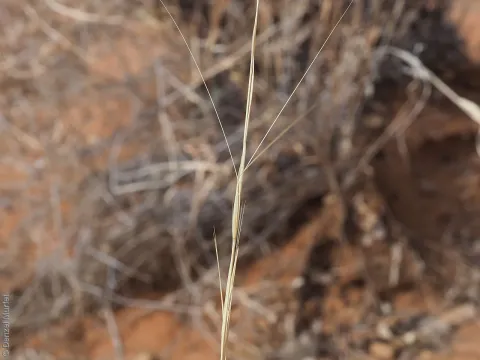
Sand wiregrass
Aristida arenaria
Aristida arenaria, commonly known as sand wiregrass, belongs to the Poaceae family. This perennial grass is a robust species naturally adapted to survive in harsh arid environments.
What the section contains
Sand wiregrass
It originates from Australia and is widely distributed across sandy deserts and semi-arid grasslands. The plant is well-known for its ability to thrive in extremely nutrient-poor and sandy soil conditions.
Botanically, it forms dense tussocks consisting of thin, rolled leaves that help the plant retain moisture. The inflorescence is a panicle characterized by long, three-branched awns that facilitate seed dispersal by wind.
The climate requirements include high heat tolerance and the ability to withstand long-term drought. Its deep root system allows it to stabilize loose sands, making it ecologically valuable for preventing desertification.
Its primary agricultural use is as a roughage source for livestock in extensive grazing systems. While not a high-energy crop, it provides essential feed in areas where more demanding species cannot establish.
Sand wiregrass exhibits significant natural resistance to most agricultural diseases. Due to its adaptation to arid conditions, fungal issues common to cereal crops are rarely observed in this species.
Insect pests, primarily grasshoppers and locusts, represent the most frequent threat to the foliage during periodic population booms. These insects consume green matter and can affect the plant's recovery rate.
Root rot is the most significant pathological risk, though it occurs exclusively in scenarios of artificial over-irrigation or abnormal flooding. The plant is not biologically equipped to manage saturated soil environments.
There are no major viral or bacterial diseases that significantly impact the productivity of wild Aristida populations. The plant maintains a healthy state as long as its environmental niche is preserved.
Ecological threats include habitat disturbance and competition from invasive plant species. Human activity and land clearing often disrupt the soil stability required for this grass to successfully propagate.