
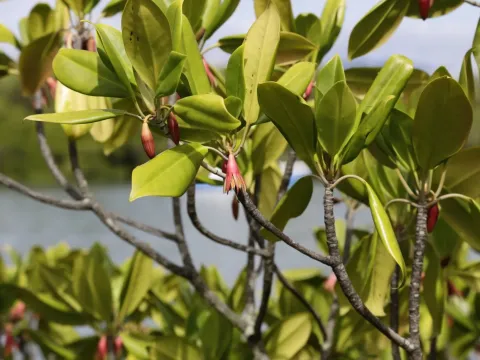
Bruguiera
Bruguiera
Bruguiera is a genus of evergreen trees belonging to the Rhizophoraceae family. These plants are essential components of mangrove forests, thriving in the intertidal zones of tropical and subtropical regions across the globe.
What the section contains


Bruguiera
The growth of Bruguiera is strictly tied to specific environmental conditions, including constant exposure to saline water and periodic flooding. The trees have developed specialized structures known as knee-roots, or pneumatophores, which allow them to exchange gases in oxygen-poor, waterlogged substrates.
Climate requirements for Bruguiera include high ambient temperatures and consistently high humidity. They require quiet coastal areas such as estuaries, lagoons, or sheltered bays, where soft, nutrient-rich silt deposits provide the necessary foundation for their root systems.
Cultivation of this species is technically complex because it requires an active tidal regime. Bruguiera exhibits vivipary, meaning its seeds germinate while still attached to the parent tree, producing propagules that drift in the water until they settle into the soft mud.
The biological resilience of Bruguiera to salinity is a result of complex filtration systems in the roots and salt-secreting mechanisms in the leaves. This adaptation allows the species to dominate vast areas of the coastline, effectively securing the soil against erosion.
The primary economic use of Bruguiera involves the harvesting of its timber. The wood is renowned for its high density, durability, and resistance to decay, making it an excellent material for building pylons, fence posts, and marine infrastructure.
Traditionally, the bark of Bruguiera has been highly valued for its high tannin content. These tannins are extracted and used in the leather tanning process or for dyeing textiles and fishing nets, contributing to local sustainable livelihoods.
Harvesting practices are generally subject to strict environmental regulations. Because mangrove forests are critical buffers against storm surges and coastal erosion, unsustainable logging can lead to catastrophic consequences for local ecosystems and human settlements.
Modern forest management focuses on selective harvesting and replanting strategies. Collecting propagules for reforestation programs is currently a significant activity in many tropical countries aiming to restore degraded coastal environments.
Future prospects for Bruguiera involve integrating traditional knowledge with scientific forest management to ensure that the ecological services of the mangrove forests are maintained while providing necessary forest products for local populations.