
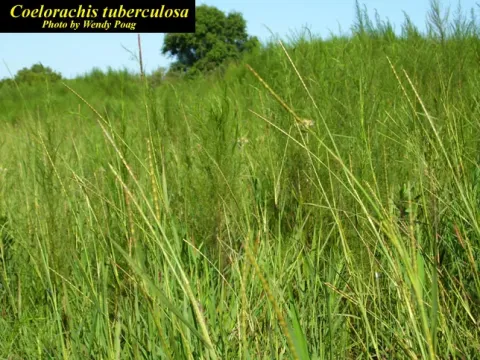
Coelorachis
Coelorachis
Coelorachis is a perennial warm-season grass, and its sowing time is dictated by soil temperature. Planting is typically conducted in the spring once the soil temperature consistently reaches 12–15°C, ensuring optimal conditions for germination.
What the section contains


Coelorachis
Proper soil preparation is crucial for success. The seedbed should be finely tilled, level, and free of debris to ensure uniform seed depth, which should ideally be between 2 and 3 centimeters to facilitate moisture contact while allowing for emergence.
Because Coelorachis establishes itself relatively slowly in its first year, weed control during the seedling stage is critical. Establishing a clean seedbed before planting helps mitigate competition from faster-growing annual weeds.
When selecting a planting site, consider soil texture and fertility. While the crop is adaptable, it performs best on well-drained but moisture-retentive soils that have been enriched with basic phosphorus and potassium fertilizers prior to sowing.
Using high-quality, viable seeds is essential for achieving the desired stand density. Proper calibration of seeding equipment ensures an even distribution of the crop, which is vital for long-term pasture productivity.
Botanically, Coelorachis belongs to the Poaceae family. It is a robust grass known for its ability to thrive in diverse environments, including tropical and subtropical climates, where it exhibits excellent heat tolerance.
The crop prefers full sun exposure to maintain high rates of biomass production. It is highly valued for its ability to adapt to varying soil conditions, including those that may experience temporary waterlogging, which often limits the growth of other grass species.
Regarding soil chemistry, Coelorachis is relatively tolerant to a range of pH levels, though it performs optimally in slightly acidic to neutral soil environments. It responds favorably to nitrogen applications, which boost leaf development and overall canopy density.
The root system of Coelorachis is well-developed, allowing it to provide significant soil stabilization on sites prone to erosion. This makes the plant useful not only for livestock production but also for land reclamation and soil conservation projects.
Effective management requires periodic maintenance, such as mowing or light grazing, to stimulate regrowth. This practice prevents the plant from reaching an overly mature stage, which would compromise the nutritional quality of the forage.
The yield of Coelorachis is significantly influenced by management practices such as fertilization and irrigation. Under optimal conditions, the grass can provide multiple harvests throughout the growing season, contributing to sustainable feed production.
As a perennial crop, its productivity usually increases from the second year onwards as the root system becomes more extensive. Well-managed fields can remain productive for several years, providing a reliable source of forage for cattle and other ruminants.
Coelorachis is primarily utilized for hay and silage production. For the best nutritional profile, it is recommended to harvest the grass just before or at the very beginning of the flowering stage, when the nutrient-to-fiber ratio is most favorable.
Intensive management includes post-harvest fertilization to encourage rapid regrowth. This practice ensures that the crop maintains high vigor throughout the active growing season, maximizing the cumulative biomass output per hectare.
When harvesting, ensure the stubble height is left sufficient to protect the growth points of the plants. Proper timing and technique are essential to ensure the longevity of the stand and to prevent the depletion of carbohydrate reserves in the roots.
Like many grasses, Coelorachis may be susceptible to fungal diseases such as rusts and leaf spots, particularly during periods of high humidity and poor air circulation within the stand. Regular field monitoring is necessary to identify outbreaks early.
Pests, particularly soil-dwelling insects like wireworms, can damage the root systems of younger plants, leading to reduced vigor. Surface-dwelling pests, such as aphids, can also cause localized damage by sap-sucking, which stunts growth.
To prevent disease accumulation, a sound crop rotation plan should be implemented. Avoiding the continuous cultivation of grasses on the same land helps break the life cycles of common soil-borne pathogens and insect pests.
In case of severe infestations, integrated pest management (IPM) should be applied. This includes using biological controls or selective pesticides only when the economic threshold for damage has been exceeded, ensuring environmental safety.
Maintaining a healthy, well-fertilized stand is the best natural defense against pests and diseases. Vigorous plants have a higher tolerance for biotic stressors and recover more quickly from potential damage, ensuring the long-term viability of the pasture.