
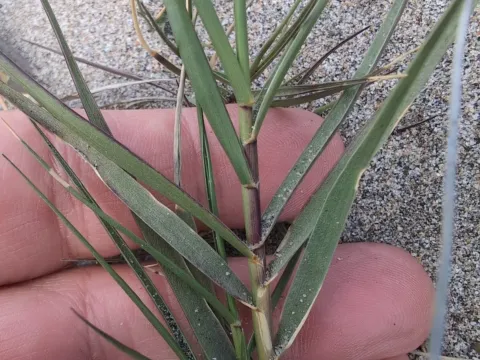
Cordgrass
Spartina Schreb.
Sowing of Spartina is generally carried out in the spring period when soil temperatures are sufficient to activate seed germination processes.
What the section contains

Cordgrass
Seeds should be planted at a shallow depth to ensure adequate contact with moist soil, which is critical for achieving uniform seedling emergence.
The use of specialized seeding equipment is recommended to maintain the optimal planting density per hectare, ensuring a productive stand.
Proper soil preparation is essential; the field should have sufficient moisture, as this crop has specific water requirements during its initial growth phase.
In regions with milder climates, late-autumn seeding is possible, provided that seed depth is carefully controlled to prevent premature sprouting during winter thaws.
Spartina belongs to the Poaceae family and is renowned for its exceptional tolerance to high soil salinity, making it an ideal candidate for coastal areas.
The plant thrives in moist, often waterlogged environments and can easily withstand prolonged flooding of the root system, which is fatal to most other crops.
Optimal growth is observed in loam or clay soils rich in organic matter, although the crop demonstrates remarkable adaptability to various soil types.
As a perennial grass with a robust root system, Spartina plays a vital role in stabilizing shorelines and preventing soil erosion in river delta zones.
Climatically, the plant is quite versatile, though it requires a sufficiently long growing season with high temperatures to achieve maximum biomass production.
The yield of Spartina is largely dependent on stand density and the availability of nutrients; under intensive management, biomass production is significant.
With adequate water availability, multiple harvests per growing season are possible, making the crop an economically viable option for many agricultural operations.
When grown for forage, harvest timing is crucial because the stems tend to become lignified and lose nutritional value if left to mature for too long.
The application of fertilizers on Spartina plantations significantly boosts the output of hay or silage, ensuring consistent productivity over several years.
Beyond agricultural yield, Spartina is highly valued for its phytoremediation potential, effectively sequestering carbon and desalinating marginal soils.
Despite its environmental resilience, Spartina can be affected by specific pests that feed on grasses, including various species of aphids and caterpillars.
The primary diseases affecting this crop are fungal infections such as rust and various smuts, which thrive in high-humidity conditions.
The risk of disease increases significantly in dense stands, making proper field management and aeration key components of an effective plant protection strategy.
Competition from weeds is mainly a threat during the initial establishment phase; once established, the root system effectively suppresses competing vegetation.
Soil-dwelling pests like wireworms may occasionally damage the underground structures of young plants, requiring vigilant field monitoring.
Harvesting should occur at the onset of the flowering stage, when the nutritional content of the leaves is at its peak before the stems become too fibrous.
Standard mower-conditioners are used for cutting, which facilitates a faster drying process for the harvested material directly in the field.
For silage production, the crop should be chopped immediately after cutting to preserve the moisture content and nutritional profile of the product.
Maintaining the correct cutting height is essential to allow for rapid regrowth of the vegetation, supporting multiple harvests within a single season.
Post-harvest management involves pressing or ensiling the biomass to prevent decay, especially when dealing with the high initial moisture content of the crop.