
Blue grama
Bouteloua hybr.
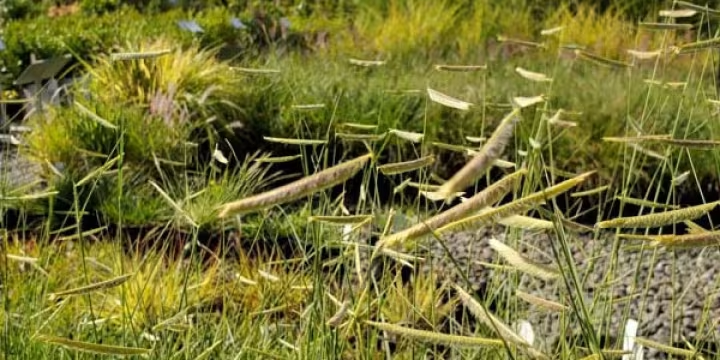
Description
Sowing dates
Blue grama is a warm-season perennial grass that requires well-warmed soil to germinate effectively, usually from late spring to early summer.
The optimal soil temperature for successful sowing is typically between 18 and 22 degrees Celsius, ensuring rapid seedling emergence.
Drilling the seeds into a firm seedbed at a depth of about 1 to 2 centimeters is crucial for maintaining consistent moisture contact.
Using a precision seed drill helps in achieving uniform plant spacing, which reduces inter-plant competition for soil nutrients.
Post-sowing rolling is recommended to compact the soil slightly, which encourages better seed-to-soil contact and improves emergence rates.
Growing requirements
As a member of the Poaceae family, blue grama is native to the North American prairies and is highly adapted to semi-arid environments.
This species is extremely photophilic, requiring full sun exposure throughout the day to achieve its maximum biomass production potential.
Well-drained soils, ranging from sandy loams to heavier clays with good structure, are ideal for supporting this grass's extensive root system.
Blue grama is famous for its exceptional drought tolerance, allowing it to survive periods of intense heat and prolonged moisture deficit.
The plant shows high soil pH adaptability, though it thrives best in neutral to slightly alkaline conditions common in its native range.
Yield
Forage yield in blue grama stands is determined by the availability of moisture and nitrogen, especially during the peak summer growing season.
Under optimal management, this grass provides high-quality forage that is rich in proteins and carbohydrates, suitable for livestock grazing.
Timely harvesting or managed grazing is essential, as the nutritional quality of the leaves tends to decrease as the plant reaches maturity.
Grazing rotation helps in maintaining the health of the stand, allowing the plants to recover and build energy reserves in the crown and roots.
Yield capacity remains stable over several years if the stand is not overgrazed and receives occasional seasonal nutrient supplementation.
Main diseases and pests
Fungal diseases, particularly rusts and smuts, can become prevalent in humid microclimates or years with above-average rainfall.
Insects like grasshoppers and aphids can cause significant defoliation, especially in younger stands that have not yet established a dense root system.
Effective weed management is vital during the establishment year because blue grama seedlings are slow-growing and can be easily outcompeted.
Waterlogging is a major stress factor that often leads to root rot and loss of plant vigor, making site selection based on drainage critical.
Integrated pest management strategies, including monitoring and biological control, are recommended to protect the integrity of the forage stand.