
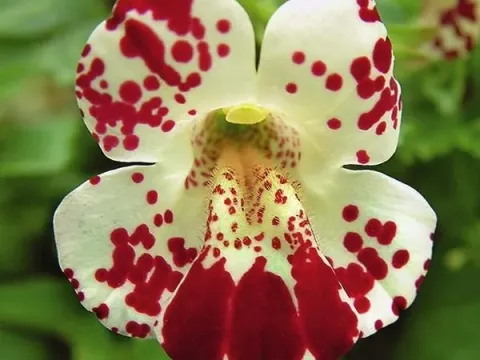
Monkeyflower
Mimulus
The sowing of Mimulus seeds for transplant production typically occurs in late March or early April. Because the seeds are extremely small, they should be sown on the surface of pre-moistened growing medium without covering them with soil, as they require light to germinate effectively.
What the section contains
 Copper musk flower
Mimulus cupreus hort. ex Dombrain
Copper musk flower
Mimulus cupreus hort. ex Dombrain
 Hybrid monkeyflower
Mimulus x hybridus hort. ex Voss
Hybrid monkeyflower
Mimulus x hybridus hort. ex Voss
 Hybrid monkeyflower
Mimulus naiandinus J. M. Watson & C. Bohlen x Mimulus cupreus hort. ex Dombrain
Mimulus naiandinus
Mimulus naiandinus J. M. Watson & C. Bohlen
Hybrid monkeyflower
Mimulus naiandinus J. M. Watson & C. Bohlen x Mimulus cupreus hort. ex Dombrain
Mimulus naiandinus
Mimulus naiandinus J. M. Watson & C. Bohlen
 Monkeyflower
Mimulus guttatus Fisch. ex DC.
Monkeyflower
Mimulus guttatus Fisch. ex DC.
 Scarlet monkeyflower
Mimulus cardinalis Douglas ex Benth.
Scarlet monkeyflower
Mimulus cardinalis Douglas ex Benth.
 Yellow monkeyflower
Mimulus luteus L.
Yellow monkeyflower
Mimulus luteus L.
Monkeyflower
Optimal germination conditions include a temperature range between 18 and 20 degrees Celsius and consistently high humidity. Seed trays are kept under covers to maintain moisture until sprouts emerge, after which they are gradually introduced to lower humidity levels.
Pricking out the seedlings takes place when the first two true leaves appear, roughly three to four weeks after sowing. Transplanting them into individual containers encourages a strong root system, which is essential for healthy plant development prior to final outdoor placement.
Pinching the growing tips when the plants reach the 3-4 leaf pair stage is a crucial cultural practice. This action promotes lateral branching and creates a denser, more bush-like habit, leading to a significantly higher number of flower blooms during the season.
Plants are hardened off and transplanted into the garden once the threat of spring frost has completely passed. Mimulus adapts well to new environments if the root ball remains undisturbed during the planting process.
Mimulus, a member of the Phrymaceae family, is native to various regions in North and South America, typically thriving in moist environments. It is widely cultivated for its vibrant, snapdragon-like flowers that provide high aesthetic value in both landscape and container gardening.
The crop requires soil with high moisture-retention capacity. Heavy loams or clay-based soils are preferred, though organic amendments are often added to improve nutrient levels and texture. Proper moisture management is the most important factor in maintaining plant vigor.
Climatically, Mimulus performs best in cooler, temperate conditions. While it can grow in sun or partial shade, extreme summer heat often causes the plant to go dormant or decline in flowering, necessitating frequent irrigation to sustain growth.
Soil nutrient levels should be kept moderate to high through the application of balanced fertilizers every two weeks during the active vegetative and flowering stages. Over-fertilization should be avoided to prevent excess foliage growth at the expense of floral production.
Economically, Mimulus serves as a key ornamental species for garden beds, hanging baskets, and as a groundcover in moist, shaded areas of the landscape. Its versatility makes it a popular choice for commercial greenhouse production and urban landscaping projects.
The crop is vulnerable to several fungal and viral pathogens, particularly when grown under high-density or high-humidity conditions. Common threats include Pythium root rot and Botrytis (gray mold), which attack the roots and foliage, respectively.
Powdery mildew represents a significant risk in fluctuating climate conditions, characterized by the appearance of a white powdery coating on leaves. Management involves optimizing airflow and humidity levels to discourage spore germination.
Viral infections such as Impatiens necrotic spot virus and Aster yellows are particularly problematic, as they can cause irreversible stunting and yellowing. Because there is no chemical cure, controlling insect vectors like aphids and thrips is the primary prevention strategy.
Crown gall (bacterial infection) can be identified by abnormal growth or tumors on the roots. Infected plants should be removed and destroyed immediately to prevent the spread of the bacteria within the soil profile or greenhouse substrate.
- Aphids and whiteflies as major vectors for virus transmission.
- Slugs and snails, which can cause severe defoliation of young plants in wet conditions.