
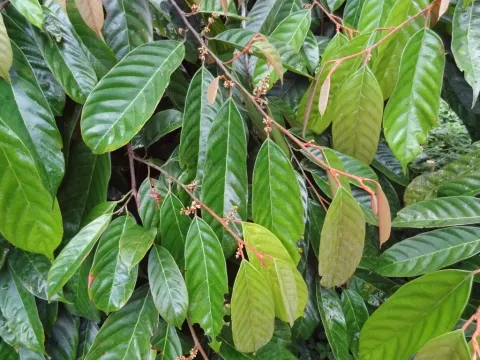
Coula
Coula
Coula (genus Coula) is a group of tropical trees within the Olacaceae family. The most prominent species, Coula edulis, is a significant wild-harvested nut tree native to the tropical forests of West and Central Africa.
What the section contains

Coula
The tree thrives in humid tropical rainforests, typically requiring an annual rainfall of at least 1500 to 2000 mm. It is shade-tolerant in its early stages of development, which is a vital adaptation for survival under the dense canopy of tropical forests.
Soil requirements for Coula include deep, fertile, well-draining loamy or clay soils. The tree is sensitive to waterlogged conditions and prefers well-aerated forest floors, which prevents root rot and supports healthy nutrient uptake.
Optimal growth occurs at temperatures between 22 and 30 degrees Celsius. As a species tied to the equatorial climate, it lacks tolerance for cold snaps or prolonged dry seasons, making it highly specific to stable, warm regions.
Agroforestry practices involve the selective management of wild Coula trees. Efforts are concentrated on protecting seedlings and maintaining the surrounding soil environment to ensure that the natural forest ecosystem continues to support high production levels.
The yield of a mature Coula tree is significant, contributing to its status as a vital non-timber forest product. Each tree produces edible nuts that are highly valued for their nutritional composition, specifically their protein and fat content.
Productivity varies based on the tree's maturity and its competitive environment. Under suitable forest conditions, a single mature Coula tree can produce substantial quantities of nuts annually, providing a consistent source of food for local communities.
The quality of the nuts is determined by the timing of the harvest. Nuts gathered soon after falling to the forest floor retain the best internal quality, preventing degradation from high humidity and fungal attacks.
Natural wildlife often consumes a portion of the harvest, which is part of the ecological cycle of the species. This interaction is essential for seed dispersal, ensuring the regeneration of the tree population in its native range.
Future agricultural potential rests on identifying high-yielding genotypes. Developing small-scale forest garden systems could further improve yields while maintaining the ecological integrity of the regions where these trees grow.
Harvesting Coula nuts is predominantly a manual, labor-intensive process. As nuts ripen, they fall to the forest floor, requiring daily collection efforts during the peak fruiting season to maximize the yield before damage occurs.
Once gathered, the nuts undergo primary processing to remove the fleshy outer layer. Removing this layer is critical to prevent moisture retention, which is the primary cause of spoilage in the humid tropical climate.
Drying the nuts is an essential step, typically carried out in shaded, well-ventilated areas to reduce moisture content within the kernel. Properly dried kernels can be stored and transported to local markets as a valuable trade commodity.
Logistical challenges are common, as harvest sites are often deep within remote forest areas. Improving access to these sites and centralizing processing facilities are current goals for increasing the efficiency of the Coula nut trade.
The nuts are highly versatile and are consumed in various ways, including fresh, boiled, or roasted. Additionally, the extraction of nutritious oils from the kernels represents a growing commercial interest for both local consumption and export.