
Medinilla
Medinilla Gaudich.
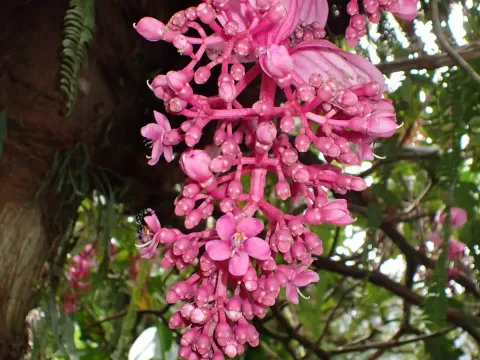
Medinilla (Medinilla) is a genus of evergreen shrubs and epiphytes belonging to the Melastomataceae family. Native to the tropical regions of Africa, Asia, and the Pacific Islands, these plants are highly valued for their unique hanging flower clusters.
What the section contains


Medinilla
The culture requires a high-humidity environment, typically exceeding 70%, which is essential for healthy development. Greenhouse cultivation must include precise humidity control and regular misting to prevent physiological disorders.
Soils must be porous, well-draining, and acidic. A mixture containing orchid bark, peat moss, and perlite is the agricultural standard to ensure sufficient oxygen supply to the sensitive root system and prevent saturation.
Optimal growth occurs at temperatures between 20°C and 25°C. Exposure to sudden temperature drops or drafts can trigger significant physiological stress, often resulting in flower bud abscission or stunted vegetative growth.
Lighting management is critical: bright, filtered light is preferred. High-intensity direct sun causes leaf scorch, while shade-dwelling conditions lead to poor flower initiation and elongated, weak stems.
Common pests include spider mites, which thrive in low-humidity conditions, and mealybugs that congregate in the leaf axils and stems, extracting plant sap.
Fungal pathogens such as root rot (Phytophthora spp.) and gray mold (Botrytis) are the primary threats, typically induced by poor drainage, overly dense growing media, or excessive overhead irrigation.
Scale insects can also infest the plants, creating sticky honeydew residues that promote the growth of sooty mold, further reducing the photosynthetic capacity of the leaves.
Pest management involves regular scouting and the application of appropriate acaricides or systemic insecticides when infestation thresholds are exceeded.
Good agricultural practices, such as maintaining proper air circulation and strictly controlled irrigation regimes, remain the most effective methods for disease and pest prevention in commercial Medinilla production.