
Cacao
Theobroma
Cacao (Theobroma cacao) is an evergreen tree belonging to the Malvaceae family. In its natural habitat, it reproduces via seeds, which lose viability within days of extraction from the fruit, necessitating immediate sowing in a nursery environment.
What the section contains


Cacao
Commercially, seeds are planted in sheltered nursery beds. High-quality production often utilizes vegetative propagation, such as budding or grafting, to ensure the consistency of desirable genetic traits from the parent tree.
For seed-based propagation, 2–3 seeds are planted at a depth of 2-3 cm. Once the seedlings reach a height of 30–50 cm, they are carefully transplanted into their permanent plantation site.
Acclimatization is a crucial phase; young plants are typically planted under the canopy of nurse trees, such as bananas or Erythrina species, to protect them from excessive solar radiation and desiccating winds.
Originating from the Amazon basin, the current global cultivation is concentrated within the equatorial belt, spanning across West Africa, Southeast Asia, and Latin America.
Cacao is highly demanding regarding its microclimate. The crop requires consistent temperatures between +24°C and +28°C throughout the year, as temperatures below +15°C significantly inhibit development.
The tree requires high humidity and well-distributed rainfall, totaling between 1500 and 2500 mm annually. Adequate soil drainage is essential, as waterlogged conditions lead to rapid root decay.
Soil quality must be rich in organic matter with a slightly acidic to neutral pH (6.0 to 7.5). Deep, well-aerated alluvial soils with high humus content are preferred for optimal growth and nutrient uptake.
Light management is nuanced; while saplings require significant shade, mature trees can tolerate higher light levels, although sustained productivity is usually higher under partial shade conditions that mimic the forest understory.
Site selection must account for wind protection. Due to its relatively shallow root system and brittle wood, cacao trees are susceptible to structural damage during strong windstorms.
Yield capacity depends heavily on the variety (Criollo, Forastero, or Trinitario) and management intensity. Trees typically begin yielding fruit 3–5 years after planting, with peak productivity occurring between 10 and 25 years.
Average yields range from 400 to 800 kg of dry beans per hectare. With advanced agro-management, optimized nutrient application, and improved clonal material, yields can reach 1500–2000 kg per hectare.
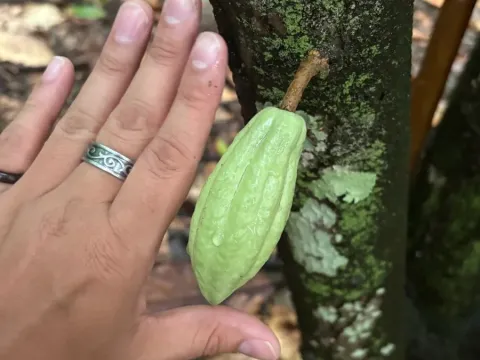
Flowering and fruiting occur continuously, though most regions experience two distinct harvest peaks per year. The plant exhibits cauliflory, with flowers and pods emerging directly from the trunk and major branches.
A single mature tree may produce 20 to 50 pods per season. Each fruit, weighing between 300 and 500 grams, typically yields approximately 30–50 grams of dried beans ready for processing.
Consistent yields are maintained through rigorous pruning, which removes water sprouts and diseased limbs, ensuring adequate airflow and reducing the humidity favorable for fungal proliferation.
The most devastating threat to cacao is Witches' Broom disease (Moniliophthora perniciosa), which deforms buds and shoots, causing tissue necrosis and significant loss of reproductive potential.
Black pod rot, caused by various species of Phytophthora, represents a major threat globally. It destroys pods at any stage of development, often causing total crop failure in humid, high-rainfall environments.
Pest pressures are significant, with Mirids (capsids) causing widespread damage by piercing young shoots and developing pods, leading to stunted growth and secondary infection points.
Mealybugs are also economically significant as they serve as vectors for the Cacao Swollen Shoot Virus (CSSVD), a lethal viral condition for which there is currently no chemical cure.
Boring insects and bark beetles pose structural risks by damaging the xylem and phloem, which disrupts nutrient transport and eventually kills the tree if not addressed through sanitary management.
Harvesting is a manual operation. Pods are carefully removed from the trunk using machetes or specialized pruning hooks, taking extreme care not to injure the flower cushions, which are necessary for future production cycles.
Post-harvest, pods are opened to extract the seeds embedded in the mucilaginous pulp. The beans undergo fermentation, a critical biological process that develops the chemical precursors for chocolate flavor and aroma.
Fermentation occurs in wooden boxes or leaf-covered heaps for 2 to 7 days, allowing for temperature elevation and the biochemical breakdown of seed components.
Post-fermentation, the beans must be dried to a moisture content of 7–8%. This is typically done on solar drying beds to ensure stability and prevent the growth of storage molds.
The final product is graded, packaged in burlap sacks, and transported for industrial processing, including cleaning, roasting, and manufacturing into cocoa mass or chocolate products.