
Selliera radicans
Selliera radicans
Description
Growing requirements
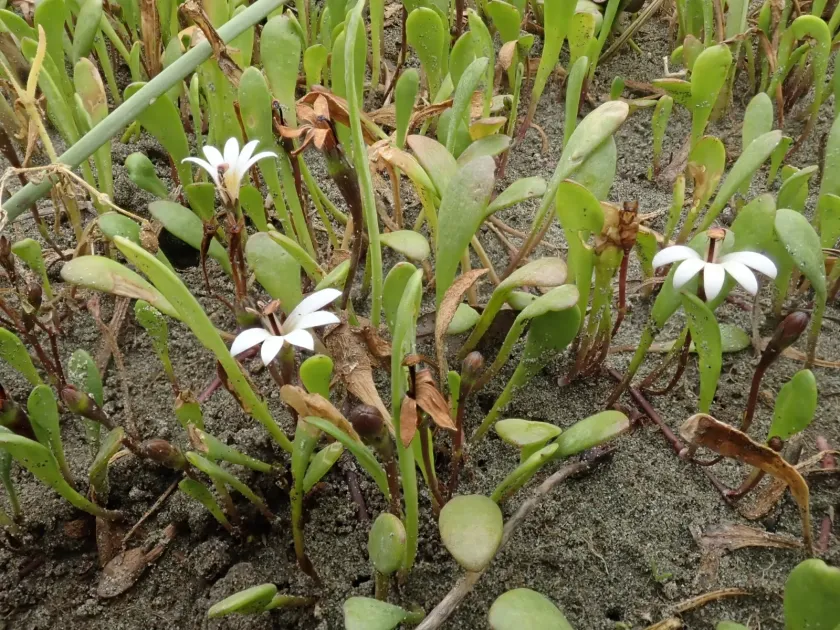
Selliera radicans, commonly known as swamp weed, is a hardy perennial belonging to the Goodeniaceae family. It is native to the coastal regions of Australia, New Zealand, and Chile, where it thrives in damp, saline habitats.
This species is well-known for its prostrate growth habit, forming a dense mat of succulent, spoon-shaped leaves. Its ability to thrive in salt-marsh conditions makes it an excellent choice for reclamation projects and coastal landscaping.
Optimal growth is achieved in consistently moist soils. While it can adapt to various soil types, including sandy or clay-based media, a well-draining substrate with high organic matter content provides the best results for garden specimens.
Regarding climate, Selliera radicans prefers temperate conditions. It exhibits high tolerance for coastal winds and salt spray, which often damage other plant species, but requires protection from severe frost and prolonged freezing temperatures.
Cultivation requires minimal fertilizer, as the plant is adapted to nutrient-poor environments. Over-fertilization can often lead to excessive leafy growth at the expense of root density, which is crucial for soil stabilization purposes.
Main diseases and pests
While relatively resistant to common pests, Selliera radicans can occasionally fall victim to sap-sucking insects such as aphids or spider mites, particularly when grown in greenhouse conditions with poor air circulation.
Fungal diseases related to root rot are the primary threat if the soil remains waterlogged for extended periods. Ensuring good drainage is essential to preventing the development of pathogens that target the root crown.
Competing weeds can be a significant issue in the establishment phase. Because Selliera grows relatively slowly at first, regular weeding is necessary until the plant forms a thick, uniform mat that can naturally shade out unwanted species.
In high-moisture environments, slugs and snails may graze on the young, tender foliage. Implementing integrated pest management strategies, such as physical barriers or biological controls, is advisable in sensitive garden settings.
Monitoring for signs of leaf yellowing or stunted growth is recommended, as these are typically early indicators of nutrient imbalance or incorrect soil moisture levels, requiring immediate adjustment of the irrigation schedule.