
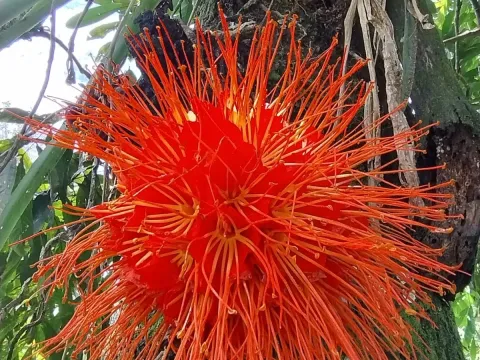
Brownea
Brownea
Brownea is a genus of evergreen trees and shrubs belonging to the legume family (Fabaceae). In their natural habitat, these plants are primarily found in the tropical rainforests of South and Central America, where they typically occupy the lower forest understory.
What the section contains


Brownea
For successful cultivation, the crop requires specific tropical conditions with high atmospheric humidity and stable temperatures year-round, ideally not dropping below 18-20 degrees Celsius.
The growing substrate must be rich in organic matter, well-drained, and have a slightly acidic to neutral pH level, as the plant is highly sensitive to waterlogging around its root system.
From an agronomic perspective, Brownea is prized as a highly ornamental crop that requires protection from direct sunlight, which can scorch tender young foliage, and it necessitates consistent moisture management.
The primary economic use of Brownea is limited to ornamental gardening and landscape design in tropical climates, where it is valued for its large, vibrant flower clusters that resemble rhododendron blooms.
The main threats to the plant under cultivation are fungal diseases, which often occur due to poor air circulation and excessive moisture in the root zone.
Pests, such as spider mites and scale insects, frequently attack weakened specimens, particularly in greenhouse environments where humidity levels may fluctuate.
To manage pest populations, agronomists recommend regular visual inspection of the foliage and the application of modern biological insecticides during the early stages of infestation.
Bacterial infections can affect the root system if irrigation protocols are violated, necessitating immediate substrate replacement and sanitation of the planting site.
Implementing strict quarantine measures when introducing new specimens helps to minimize the risk of pathogen transmission to existing botanical collections.