
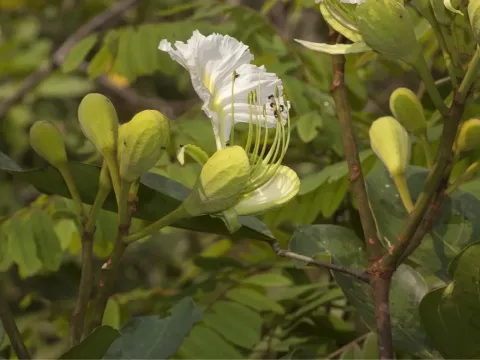
Berlinia
Berlinia
Berlinia is a genus of tropical trees belonging to the Fabaceae family, subfamily Caesalpinioideae. Primarily known for their role in African forest ecosystems, these trees are managed as a forestry resource rather than a traditional field crop.
What the section contains


Berlinia
Propagation is typically carried out via seeds. Due to the hard seed coat, scarification is necessary to ensure uniform germination rates when growing seedlings in nurseries.
Sowing should coincide with the beginning of the rainy season to provide consistent moisture for the developing root systems. Seedlings are usually nurtured in nurseries until they reach 30–50 cm in height before outplanting.
The growth rate of Berlinia is relatively slow in the early stages, necessitating weed management and protection from competitive vegetation. Planting density varies depending on the forestry objective, typically ranging from 3x3 to 5x5 meters.
Agrotechnical practices are focused on reforestation and sustainable forest management principles, emphasizing high survival rates of saplings during the establishment phase.
Berlinia thrives in humid tropical environments with stable temperatures ranging from +22°C to +30°C. The genus is not adapted to cold climates and is sensitive to frost or prolonged thermal stress.
Deep, well-drained soils are essential for healthy development. The tree prefers loamy or nutrient-rich soils that support significant root growth and biomass accumulation.
Adequate precipitation is a key requirement, with an optimal range of 1500–2000 mm of annual rainfall. Long dry seasons can hinder growth, especially for younger trees with underdeveloped root systems.
High relative humidity is beneficial for the tree throughout its lifecycle. While saplings benefit from partial shade, mature trees are canopy-forming species that excel under full sunlight conditions.
Soil drainage must be prioritized, as waterlogging can trigger root rot and other systemic health issues that significantly diminish the tree's vitality.
The economic value of Berlinia is derived primarily from its timber. The yield is calculated by the volume of merchantable wood produced per hectare over the tree's long growth cycle.
Reaching heights of up to 30 meters, Berlinia provides high-quality timber suitable for construction and furniture manufacturing. Harvesting is managed through long-term forestry plans to ensure sustainable wood supply.
In agroforestry systems, Berlinia can serve as a shade-providing tree for understory crops, creating a multifunctional land-use system that optimizes resource efficiency.
Timber yield depends heavily on soil quality, site selection, and the maintenance of appropriate stand density. Sustainable management practices are essential to balance harvest rates with natural growth cycles.
Seed production is periodic, with certain years showing heavy fruiting. Managing these cycles is important for nurseries focused on seedling production for reforestation efforts.
The genus is susceptible to various pests, particularly wood-boring insects such as termites, which can degrade the quality of the timber if left unmanaged.
Fungal pathogens, especially those affecting the root system, are significant threats in environments with poor drainage or stagnant air conditions. These diseases often lead to tree decline.
Leaf-eating insects can impact the health of nursery saplings, potentially slowing their development. Integrated pest management strategies are recommended to mitigate these risks in managed plantations.
Habitat loss and illegal logging represent the most severe threats to wild Berlinia populations. Conservation efforts and sustainable harvesting are crucial for the long-term survival of the genus.
Regular monitoring and site health management help minimize the impact of pests and diseases, ensuring the productivity of forested areas.
Harvesting of Berlinia is typically performed via selective logging of mature trees. This method prioritizes the integrity of the remaining forest and promotes natural regeneration.
Timing the harvest is based on reaching specific diameter-at-breast-height (DBH) targets, which ensure that the wood quality meets industrial requirements.
Primary processing, including limbing and debarking, is often conducted on-site to reduce transportation logistics and make wood extraction more efficient.
Seed harvesting for propagation must be synchronized with natural ripening periods. Careful handling of seeds is required to maintain viability for future nursery operations.
Sustainable forest management entails that harvest operations are balanced by replanting and protecting young growth to ensure a continuous cycle of forest productivity.