
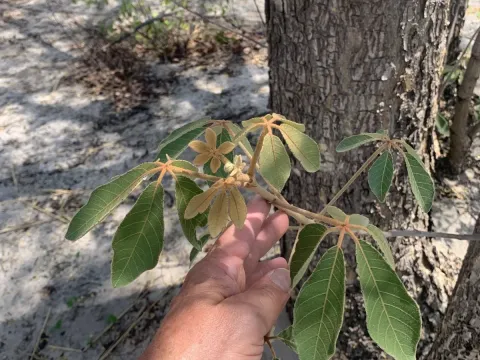
Manketti
Schinziophyton
Manketti (Schinziophyton rautanenii) is a deciduous tree belonging to the Euphorbiaceae family, native to the savanna regions of Southern Africa.
What the section contains

Manketti
The tree is renowned for its remarkable drought tolerance, making it an ideal candidate for agricultural development in extremely arid climates.
It prefers deep, well-drained sandy or rocky soils, which are typical of the Kalahari desert landscape where the species is most abundant.
Full sun exposure is essential for the healthy growth and high productivity of the tree, which can reach heights of 15 to 20 meters.
Manketti requires minimal human intervention, as it is naturally adapted to survive seasonal water shortages through its deep root system.
The primary economic output of Manketti is the Mongongo nut, which is highly valued for its dense protein and healthy fat content.
An individual mature tree can produce a substantial harvest of fruits annually, which is crucial for local food security.
The oil extracted from the nuts is rich in Vitamin E, making it a premium ingredient in the cosmetics industry for skincare products.
Beyond the nut kernel, the fruit's outer pulp is also edible and provides a sweet, nutritious source of food for both humans and wildlife.
Increasing cultivation of this tree helps in providing sustainable livelihoods in regions where traditional farming crops often fail.
The most significant threats to Manketti plantations are specific types of seed-boring beetles that can infest the nuts before and after harvest.
Young saplings are vulnerable to herbivory, as many wild animals favor the tree's tender leaves and bark during the dry season.
Fungal pathogens may target the tree if soil drainage is poor or if the trees are planted in areas prone to seasonal waterlogging.
Human impact, such as over-harvesting of young wood, can slow down the natural regeneration of the species in wild populations.
Proper fence protection and monitoring are essential for cultivated stands to ensure the survival of young trees until they reach maturity.
The harvest season coincides with the end of the dry period when the fruits drop naturally from the trees onto the forest floor.
Gathering is primarily manual, involving collecting the fallen fruits and removing the fibrous outer flesh to reach the hard shell.
The hard endocarp protects the kernel from oxidation, allowing the seeds to be stored for extended periods without degrading.
Sun-drying the nuts is a standard practice to reduce moisture content before mechanical or manual cracking to extract the kernels.
Efficient post-harvest handling ensures that the high-quality oil content of the kernels remains intact for various industrial applications.