
Marsh spurge
Euphorbia palustris
Description
Growing requirements
Marsh spurge (Euphorbia palustris) is a robust perennial herb belonging to the Euphorbiaceae family. Its natural distribution spans across wetland habitats in Europe and Western Siberia, where it thrives in moist meadows and along riverbanks.
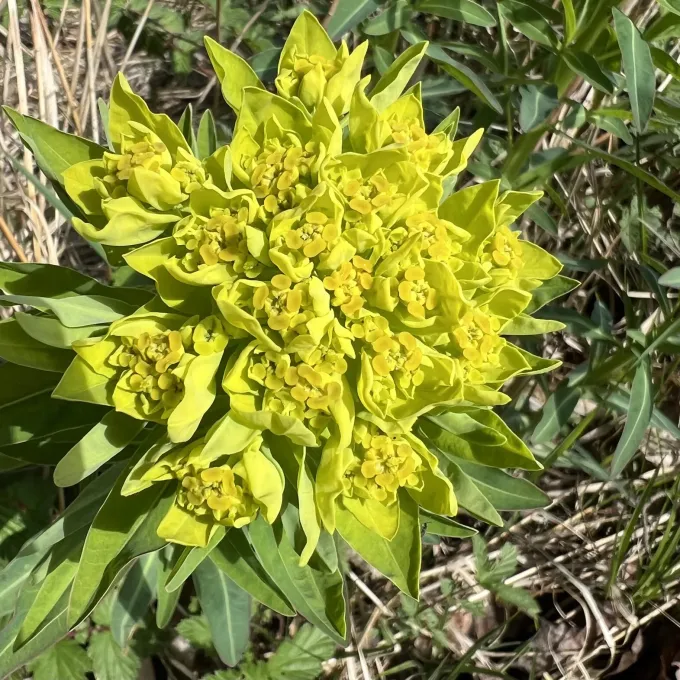
The plant is distinguished by its upright, lush foliage and significant height, often reaching up to 1.5 meters. During late spring, it produces clusters of vibrant, greenish-yellow flowers that serve as an attractive feature for garden structures.
Cultivation of this species requires constant soil moisture. It performs best in heavy, fertile soils that retain water well. Unlike many garden species, Euphorbia palustris is highly tolerant of waterlogged conditions and seasonal inundation.
In terms of climate, it is a hardy plant capable of surviving cold temperate winters. It prefers full sun exposure to maintain its dense habit and bright coloration, though it can tolerate light shade without losing its overall vigor.
Horticulturally, it is utilized as a structural plant for pond margins, rain gardens, and low-lying damp areas of a landscape, providing a lush appearance from spring through autumn when the leaves turn to shades of yellow and orange.
Main diseases and pests
Common health issues for Marsh spurge include powdery mildew and various leaf spot diseases, which typically emerge if the plants are crowded and lack proper air circulation during humid weather conditions.
Insect pests such as aphids and spider mites may occasionally infest the plant. Aphids tend to target the soft new growth of the flower stalks, while spider mites are more common in unusually dry, hot summer spells.
The plant produces a milky latex that acts as a natural deterrent against many herbivores and pests. However, this sap is known to be irritating to human skin and eyes, requiring protective gear during pruning or transplanting.
Effective management includes regular monitoring for early signs of infestations. Keeping the garden bed clear of stagnant debris and maintaining proper spacing between plants significantly reduces the risk of fungal spread.
If chemical interventions are necessary, organic or target-specific pesticides are recommended, especially when the plant is grown near natural water bodies to protect local aquatic ecosystems and biodiversity.