
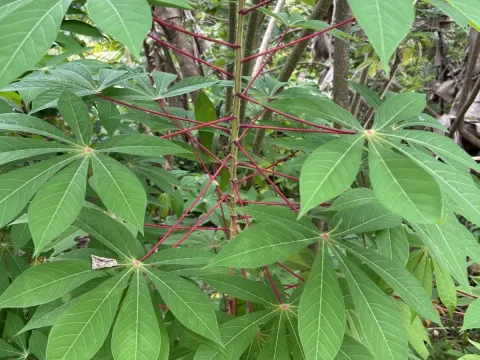
Cassava
Manihot
Cassava (Manihot esculenta) is a perennial shrub of the Euphorbiaceae family, widely cultivated in tropical regions as a key source of carbohydrates. It is propagated primarily through stem cuttings, which are 20 to 30 centimeters in length.
What the section contains


Cassava
The planting time is typically synchronized with the beginning of the rainy season, ensuring that cuttings receive sufficient moisture to develop roots and establish themselves in the soil before the drier months.
Healthy cuttings are taken from the mature, woody sections of the stems of plants between 8 and 12 months old. They are planted in loose soil, either vertically or at an angle, with two-thirds of the cutting buried underground.
A standard planting density is around 10,000 plants per hectare, with rows spaced about one meter apart. Maintaining a consistent distance between plants is crucial for allowing enough space for the subterranean root tubers to expand fully.
Weed management in the first three months is vital for the crop's success. Because cassava has a slow initial growth rate, early weeding prevents competition for sunlight, water, and essential soil nutrients.
Cassava is highly adapted to tropical climates and requires temperatures between 25 and 30 degrees Celsius for optimal growth. Cold temperatures significantly retard plant development and should be avoided.
While the plant is famous for its drought tolerance, consistent rainfall—ideally between 1000 and 1500 mm annually—is necessary to achieve high yields of high-quality storage tubers.
The crop prefers well-drained, light-textured sandy loam soils with a neutral or slightly acidic pH. Poor drainage is the most significant soil-related threat, as waterlogging frequently leads to root rot.
On heavier clay soils, planting on raised beds or mounds is a mandatory practice to ensure efficient water drainage and improve the aeration of the root zone, which is critical for tuber formation.
Cassava can thrive in relatively low-fertility soils where many other crops would fail, but it does benefit from potassium-rich fertilizers, which directly improve the starch content of the harvested tubers.
The yield of cassava is highly variable, depending on the cultivar, soil fertility, and agricultural practices. Average yields range from 10 to 25 metric tons of fresh tubers per hectare.
With optimized management, including the use of improved high-yielding varieties and efficient nutrient application, production can scale up to 40 tons or more per hectare in commercial farming operations.
Storage roots grow continuously throughout the crop's lifecycle, meaning that the longer the plant remains in the ground, the larger the roots become, although they may eventually lose quality.
Harvest planning is essential, as the optimal time for pulling the roots depends on whether the crop is intended for fresh consumption or for the industrial extraction of tapioca starch.
Farmers must also account for daylight length, as cassava is sensitive to photoperiod; thus, varieties must be chosen according to the specific latitude of the cultivation site to maximize biomass production.
The most devastating threats to cassava production are viral diseases, most notably the Cassava Mosaic Disease (CMD), which can drastically reduce leaf surface area and tuber yields.
Common insect pests include whiteflies, mites, and mealybugs. These pests suck nutrients from the leaves and can act as vectors for viral pathogens, requiring rigorous integrated pest management strategies.
Bacterial blight is another major pathology that causes leaf spotting and stem necrosis. It is typically managed through the use of disease-resistant varieties and strict field sanitation procedures.
Integrated Pest Management (IPM) involves a combination of biological controls, such as the introduction of predatory wasps, and selective chemical treatments to keep pest populations below the economic injury level.
Routine field monitoring and the removal of infected plants are standard practices to prevent the spread of localized outbreaks within the plantation, ensuring the long-term health of the crop cycle.
Harvesting usually occurs between 8 and 12 months after planting, depending on the maturity of the specific cultivar. Visible signs of readiness include the yellowing and shedding of the lower leaves.
In smallholder systems, harvesting is a manual process where the base of the plant is lifted using a hoe. Care must be taken to extract the tubers without causing deep wounds, as damaged roots deteriorate very quickly.
Large-scale commercial operations often use specialized mechanical harvesters that lift the entire plant from the soil, followed by automated cleaning systems to separate the roots from adhering soil and debris.
Post-harvest shelf life is extremely short, as the tubers begin to spoil within 48 to 72 hours due to physiological decay. Consequently, immediate processing is a top priority for all farmers.
Processing steps may involve peeling, washing, and grating for starch extraction, or slicing and sun-drying to create flour, which preserves the nutritional value and marketability of the cassava crop for later use.