
Caryodendron
Caryodendron
Propagation of Caryodendron is primarily achieved through seeds, as vegetative propagation remains challenging due to the plant's specific physiology. Freshly harvested seeds exhibit high germination rates but lose viability rapidly if allowed to dry out.
What the section contains

Caryodendron
In their native habitat, seeds are sown in fertile, well-drained soil immediately at the onset of the rainy season. The optimal temperature for germination should be maintained between 24 and 28 degrees Celsius.
For establishing commercial plantations, seeds should be sown at a depth of 3–5 centimeters. It is crucial to ensure consistent moisture, maintaining soil dampness without creating waterlogged conditions, which are detrimental to young root systems.
When using containerized growth methods, seedlings are kept in nurseries until they reach a height of 40–50 centimeters. Only after a robust root system has formed are the saplings transplanted into their permanent field or agroforestry positions.
Planting schedules are strictly dependent on the local climate, usually coinciding with the peak rainfall period. In equatorial regions, planting can occur year-round provided that water management and soil moisture levels are strictly monitored.
Caryodendron is an evergreen tree of the Euphorbiaceae family, capable of reaching heights up to 20 meters in the wild. It thrives in tropical rainforest conditions and tolerates shading during its early developmental stages.
The crop has stringent temperature requirements, as it cannot tolerate sub-zero temperatures and needs consistent warmth throughout the entire growing season to reach its full productive potential.
Successful growth requires deep, nutrient-rich soils with a pH ranging from slightly acidic to neutral. Proper drainage is a non-negotiable requirement, as water stagnation will quickly lead to root rot and tree decline.
The species is moisture-loving and performs best in regions with annual precipitation exceeding 2000 millimeters. During dry spells, young trees require supplemental irrigation to maintain leaf turgor and prevent wilting.
These trees exhibit excellent adaptation to life under a forest canopy, making them suitable candidates for integrated agroforestry systems. However, for maximum nut yields, mature trees eventually require significant access to sunlight.
The primary economic value of Caryodendron lies in its seeds, commonly known as Inca nuts. Each productive tree is capable of yielding a significant harvest once it reaches biological maturity and full canopy development.
The timeframe for the onset of fruit production varies based on environmental conditions, typically occurring 5–7 years after planting. Full-scale industrial exploitation of plantations usually begins after the trees surpass ten years of age.
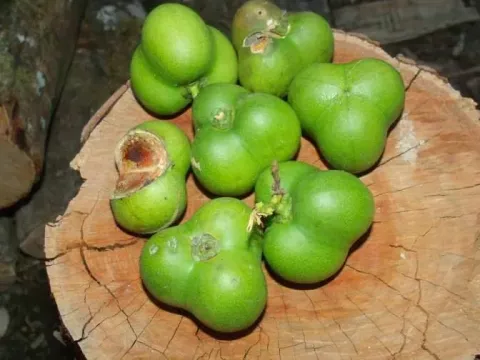
The fruits consist of three-valved capsules containing large seeds rich in fats and proteins. The high oil content makes this crop a promising candidate for producing high-quality edible and cosmetic oils.
When correct agronomic practices are followed, yields per hectare can be competitive with other regional oilseed crops. Yield stability is directly linked to the availability of nutrients during the critical fruit-set phase.
Harvesting is performed manually as the capsules mature, which helps prevent premature splitting and the resulting loss of seeds on the forest floor. Careful harvesting ensures the high quality of raw material for subsequent processing.
Common diseases for Caryodendron include fungal infections of the foliage, which are exacerbated by high humidity and poor air circulation in dense plantations. Various leaf spot pathogens can significantly reduce photosynthetic surface area.
Tropical pests, such as lepidopteran larvae and various species of weevils, can damage both young shoots and developing fruits. Regular monitoring of the canopy is essential for early detection and mitigation of infestation hotspots.
Root rot caused by soil-borne pathogens represents the most significant threat to tree health in areas with inadequate drainage. Prevention relies on adhering to strict agronomic standards and avoiding any standing water around the base.
Ants and other foraging insects can cause damage to the crop as it ripens on the tree. Implementing biological pest control methods is generally more sustainable and effective than chemical treatments in fragile tropical ecosystems.
Limited genetic selection material makes Caryodendron plantations vulnerable to emerging viral or bacterial infections. Maintaining genetic diversity within the plantation is vital for improving the overall resilience of the agro-ecosystem.
Harvesting is a labor-intensive process that requires experienced staff. Maturity is determined by observing changes in the color of the pericarp and the ease with which the capsule detaches from the branch.
Post-harvest, the fruits require immediate primary processing, which involves extracting the seeds from the capsules and cleaning them thoroughly. This is essential to prevent mold growth, to which the oil-rich kernels are highly susceptible.
Seed drying is conducted in well-ventilated, shaded areas to avoid direct sunlight. Proper drying reduces kernel moisture to levels suitable for long-term storage and prevents spoilage.
Transportation of the raw material must occur in breathable containers to ensure air circulation. Failure to maintain correct temperature and moisture regimes during storage leads to rapid rancidity of the oil within the nuts.
The final product is the cleaned nut, which undergoes mechanical pressing to extract high-quality food oil. The oil cake, which remains after extraction, serves as a valuable feed supplement, ensuring near-zero waste production.