
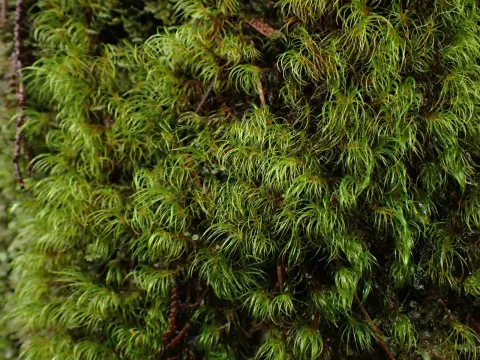
Dicranodontium uncinatum
Dicranodontium uncinatum
Dicranodontium uncinatum belongs to the Dicranaceae family. It is a perennial moss species primarily found in cool, moist forest environments, where it plays a key role in maintaining soil moisture and micro-habitat stability.
What the section contains
Dicranodontium uncinatum
The plant thrives in humid conditions, typically colonizing decaying logs, rocky substrates, and organic-rich forest floors. It is highly dependent on high atmospheric humidity to maintain its metabolic processes and tissue integrity.
Geographically, it is distributed in temperate regions with high rainfall levels. It is not an agricultural crop but is categorized as a vital component of undisturbed forest ecosystems, often serving as a biological marker.
Botanically, it forms dense, tufted mats with distinctively curved, hook-like leaves. This morphology is an adaptation to maximize moisture absorption from mist and precipitation in shaded forest environments.
Soil requirements are centered on the presence of stable, acidic, or neutral organic substrates. It requires a canopy cover to prevent desiccation from direct sunlight and to sustain the cool temperatures essential for its survival.
Climate change poses a severe threat to this species, as rising temperatures and shifting rainfall patterns lead to the drying out of its forest habitats and subsequent population decline.
Air pollution, particularly high levels of nitrogen and sulfur dioxide, is highly detrimental to bryophytes, causing physiological stress and reducing the reproductive capacity of Dicranodontium uncinatum.
Deforestation and forest management practices that remove the canopy layer lead to increased light penetration and desiccation, which typically results in the rapid death of these moisture-sensitive moss colonies.
Invasive plant species can outcompete mosses for space and resources, particularly in disturbed forest edges, further restricting the available habitat for the species.
While not heavily prone to traditional crop pests, the moss can be affected by specific fungal pathogens that thrive in stagnant, high-humidity environments, leading to the decay of the lower moss tissues.