
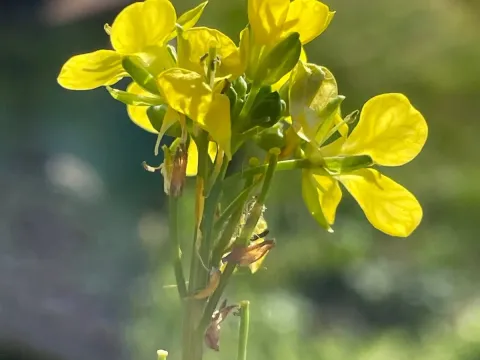
Hirschfeldia
Hirschfeldia
Hirschfeldia incana, commonly known as hoary mustard, is typically managed as a problematic weed within various agricultural cropping systems globally.
What the section contains

Hirschfeldia
Germination is highly dependent on moisture, with peak seedling emergence occurring following autumn rains in Mediterranean-type climates.
In winter cereal fields, management requires early intervention because the plant establishes a rosette phase that becomes difficult to control once winter cold sets in.
Seeding of crops must be preceded by targeted soil preparation to exhaust the seed bank of Hirschfeldia near the soil surface.
Strategic timing of herbicide applications is crucial during the early seedling stage, as older plants develop thick cuticles that reduce chemical efficacy significantly.
This species belongs to the Brassicaceae family and exhibits an exceptional ability to colonize diverse soil types, ranging from sandy loams to compacted heavy clays.
It thrives in open, high-light environments and is particularly well-adapted to disturbed sites, often becoming a dominant species in neglected fallow fields.
The plant is highly resilient to temperature extremes, demonstrating the ability to persist through mild winters while maintaining metabolic activity.
Soil fertility management significantly affects its growth, as the plant responds vigorously to nitrogen availability, often outcompeting less aggressive crop varieties.
Its deep taproot system provides a distinct advantage in drought-prone areas, allowing it to sustain growth when other weeds and crops suffer from water stress.
Hirschfeldia serves as an important reservoir for numerous pests, including flea beetles, which later migrate into commercial brassica crops like canola.
The plant is also a known host for various viral diseases that can cause significant yield reduction in economically important Brassicaceae crops.
Fungal pathogens such as white rust and downy mildew frequently utilize this host to overwinter and spread spores across agricultural landscapes.
Effective management strategies require integrated pest control, including crop rotation and the strategic use of selective herbicides in the off-season.
Failure to control outbreaks leads to rapid seed dispersal, as a single plant can produce thousands of seeds that remain viable in the soil for several years.