
Hoary mustard
Hirschfeldia incana (L.) Lagr.-Foss.
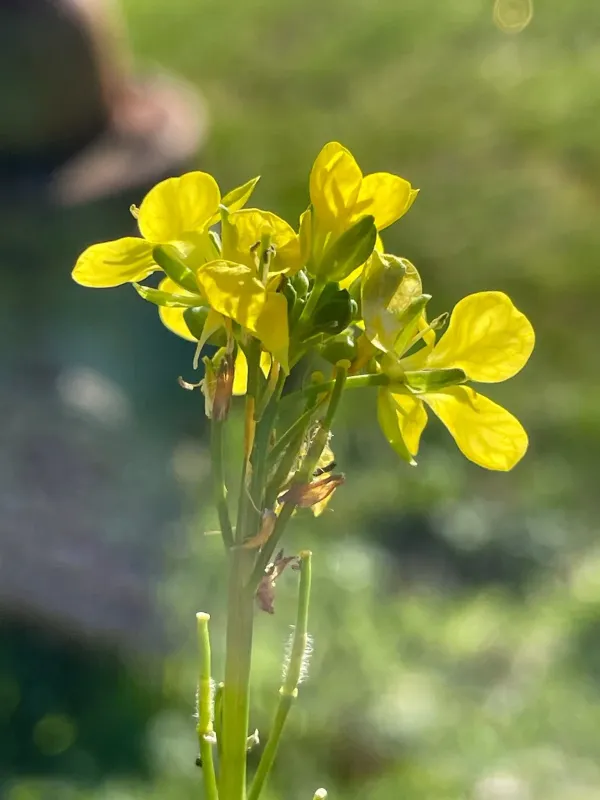
Description
Sowing dates
Hoary mustard (Hirschfeldia incana) is a persistent herb belonging to the Brassicaceae family. It is recognized as a significant agricultural weed that exhibits annual or biennial growth patterns, depending on environmental conditions.
The seeds of this plant show remarkable longevity in the soil, often remaining viable for several years. Germination primarily occurs in the spring, triggered by moderate temperatures and sufficient soil moisture levels.
Plants initially form a dense basal rosette that allows them to overwinter successfully. Once established, they develop deep taproots, enabling the plant to thrive even in challenging environments where other vegetation might struggle.
Growth is rapid, and the plant reaches the reproductive phase quickly, producing high quantities of small seeds that are easily dispersed by wind, water, and agricultural equipment. This makes containment on farmland a challenging task.
Successful management strategies focus on preventing seed set through timely cultivation. Monitoring fields early in the season is crucial to identify and eliminate young rosettes before they compete with primary crops.
Growing requirements
Hoary mustard is highly adaptable and thrives in open, disturbed habitats including field edges, pastures, and roadsides. It shows a preference for well-drained soils but can survive in a variety of soil types, including poor or alkaline ones.
The plant demonstrates significant resilience to climate fluctuations. While it prefers sunny locations with moderate temperatures, it maintains growth during cooler periods, giving it a competitive edge over heat-sensitive crops.
Nutrient requirements for Hoary mustard are relatively low, allowing it to colonize lands with low fertility. However, in nutrient-rich agricultural fields, the plant develops faster and becomes a more aggressive competitor for resources.
Effective management requires a combination of mechanical and chemical approaches. Crop rotation practices that include non-cruciferous species are highly effective in disrupting the life cycle of this weed.
Maintaining a healthy, competitive crop canopy is essential to limit the growth of Hoary mustard, as it does not compete well under conditions of heavy shading provided by thick stands of cereal or pulse crops.
Main diseases and pests
Because it belongs to the Brassicaceae family, Hoary mustard acts as a primary host for numerous pests and diseases that affect economically important crops like canola, mustard, and cabbage.
Insects such as flea beetles and aphids frequently congregate on the plant, using it as a refuge. From there, they often move to commercial crops, causing significant damage during critical growth stages.
The plant is also susceptible to pathogens that cause root rots and fungal infections. These pathogens can persist in the soil for extended periods, complicating the management of subsequent crop rotations.
Proactive management of field perimeters is necessary to reduce the pressure of these pests. Keeping the surrounding area free of Hoary mustard reduces the risk of insect migration into productive fields.
- Cabbage aphid
- Flea beetles
- Clubroot disease
- Weevils