
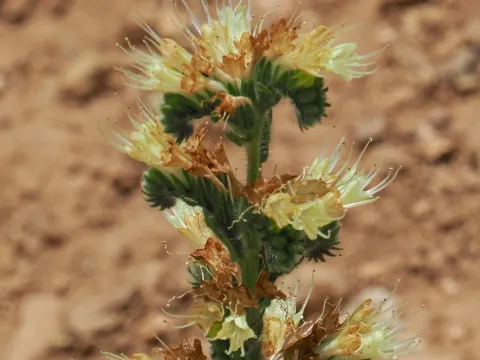
Yellow viper's bugloss
Echium flavum
Yellow viper's bugloss (Echium flavum) is a member of the Boraginaceae family. It is primarily grown as a honey plant, and successful cultivation starts with early spring sowing when soil temperatures reach 5–8 degrees Celsius.
What the section contains
Yellow viper's bugloss
Seedbed preparation is vital for this crop. Farmers should aim for a fine, firm tilth to ensure optimal seed-to-soil contact. Deep plowing followed by harrowing is recommended to facilitate proper root development in the initial stages.
The optimal seeding depth is shallow, around 1–2 centimeters. Planting seeds too deep can significantly reduce germination rates, as the small seeds lack the stored energy to emerge from deeper layers of soil.
Standard sowing patterns typically involve rows spaced 45–60 centimeters apart. This spacing allows for mechanical weeding, which is crucial during the plant's slow growth phase in the first few weeks after emergence.
The recommended seeding rate is roughly 4–6 kg per hectare, depending on local soil moisture conditions and seed viability. In regions with mild winters, autumn sowing can also be successful, leading to stronger plants in the following season.
Echium flavum is a highly drought-tolerant xerophyte. It thrives in well-drained, sandy, or loamy soils and is particularly effective in utilizing moisture from deep soil layers, making it ideal for arid regions.
The plant requires full sun exposure to maximize nectar production. Shady or heavily overcast areas significantly decrease the plant's value as a honey source, as nectar secretion is directly linked to photosynthesis and light intensity.
Neutral to slightly alkaline soils with a pH between 6.5 and 7.5 are considered optimal. Heavy, clay-rich, or acidic soils should be avoided, as they promote root rot and hinder the plant's overall vigor.
While the plant is winter-hardy, it performs best in regions where it can undergo natural vernalization. This process is critical for transitioning from the vegetative phase to the reproductive flowering stage in biennial cycles.
Proper nutrient management is necessary to balance vegetative growth and flowering. Nitrogen should be applied sparingly, while phosphorus and potassium are essential for developing robust root systems and increasing sugar concentration in the nectar.
As a premium honey plant, Echium flavum can produce between 300 and 400 kg of high-quality honey per hectare. Its nectar is rich in sugars and remains accessible to bees even during extreme drought conditions.
The flowering period is extended, lasting up to 45 days, which provides a consistent supply of forage for honeybee colonies. This stability is a significant advantage for commercial beekeepers managing large-scale operations.
Beyond its value in beekeeping, the plant yields a significant amount of seed. Under favorable management practices, farmers can expect a yield of 300–500 kg of seeds per hectare, which provides an additional revenue stream.
The honey produced from yellow viper's bugloss is highly regarded for its slow crystallization and delicate flavor profile. It is often sought after by consumers looking for artisanal, monofloral honey products.
To maximize yields, hives should be placed as close to the blooming fields as possible, ideally within 500 meters. This distance ensures that bees spend less energy on travel and more on nectar collection and hive maintenance.
The plant possesses natural defenses, such as rigid hairs (trichomes) on its stems and leaves, which deter many generalist pests. However, it is not immune to specialized insects, such as certain types of weevils.
Powdery mildew is the most common fungal threat, particularly in humid climates or where planting density is too high. Proper spacing and airflow are the best preventative measures against this disease.
Root rot caused by stagnant water or soil compaction can be detrimental to the health of the stand. Improving field drainage is essential to prevent the spread of soil-borne pathogens that compromise plant health.
Weed management remains the most challenging aspect of cultivation. Since the plants grow slowly in the initial phase, they are easily outcompeted by invasive weeds unless managed through periodic mechanical weeding.
Pest control strategies must prioritize the safety of pollinating insects. Any chemical intervention should be avoided during the peak flowering window to prevent accidental poisoning of foraging bee populations.
Harvesting for seeds begins when the seed pods turn a dark, woody brown and the seeds reach maturity. Timing is critical to prevent losses due to shattering, as the seeds detach easily when fully ripe.
A two-stage harvesting approach is most common: swathing the crop first, allowing it to dry in the field for several days, and then picking up the material for combine threshing. This ensures more uniform seed moisture.
After threshing, seeds must be cleaned using specialized sieves to remove plant debris and chaff. This process ensures the purity and long-term viability of the seed stock before storage.
Seed drying should be performed at low temperatures (below 40 degrees Celsius) to maintain germination capacity. High heat can damage the embryo and lead to a significant decline in viability during storage.
Stored seeds should be kept in cool, dry conditions with a moisture content of around 12%. When stored correctly, Echium flavum seeds can remain viable for up to four years, allowing for flexible farm planning.